

Exploration into goodness of civilizations bridges East, West
As the world enters the second quarter of the 21st century, the Environmental, Social and Governance or ESG framework — which evaluates a company's performance in such areas as social responsibility, impact investing and philanthropy — continues to gain momentum. Corporate philanthropy is shifting from simple donations to deeper engagement. The question, then, is just how businesses in Zhejiang are responding to the trend.
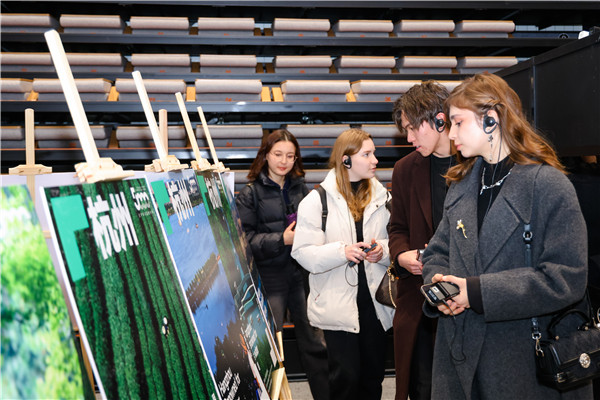
International students participate in the event.
On Feb 15, over 100 guests from 14 countries gathered for the "Civilizations of Goodness: When the East Meets the West" seminar to explore the latest trends in philanthropy, social economy, corporate sustainability and global development.
Among the guests were representatives from influential Zhejiang business enterprises, scholars from Oxford and Harvard universities, as well as international students who participated as Hangzhou League of International Students · Gen Z City Experience Officers.
The event was part of the Hangzhou, A Window to China's 5,000-Year Civilization project. It was organized by the General Association of Zhejiang Entrepreneurs Sustainable Development Commission, the Hangzhou Philanthropic Association, the Hangzhou International Communication Center and Zhejiang University Center for Civilizations of Goodness Research.
East meets West in social responsibility
Wang Lihong, chair of the Hailiang Group — a private company based in Hangzhou, capital of Zhejiang, that specializes in non-ferrous metals, construction and ecological agriculture — emphasized the province's commitment to social values. She highlighted the company's educational outreach and the contributions of other local companies — including Holley Group's fight against malaria with artemisinin and DeepSeek's substantial charitable donations — showcasing how Zhejiang enterprises were integrating social responsibility into their business models.
Similar were Alibaba's initiatives, such as the "public welfare items" on Taobao, where each purchase donates a percentage of the payment to charitable projects. Another is the 3-Hour Voluntary Service Platform, a platform that facilitates donations and volunteer services with just a few taps — demonstrating the company's commitment to community support.
Additionally, Alibaba's rural vitalization projects aim to help remote villages grow and develop — further illustrating how local enterprises in Zhejiang are leveraging their platforms and resources to contribute to the social good.
Corporate responsibility, philosophy
Dr John Hoffmire, a distinguished scholar from Oxford University's Regent's Park College, discussed the relationship between corporate ESG policies and social welfare, cautioning that AI technology could exacerbate inequality if not carefully managed. He cited Chinese tech titan Huawei's employee stock ownership model as an example of inclusive capitalism.
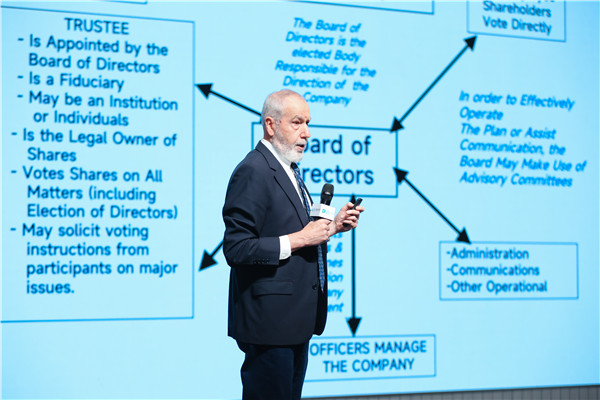
Oxford University's John Hoffmire voices a note of caution during the seminar.
Meanwhile, Dr Rey Sheng Her, associate scholar at Harvard University FAS CAMLab and deputy CEO of the Tzu Chi Foundation, connected Chinese philosophical principles to corporate charity. His insights on the integration of Confucian and Daoist values into ESG governance were illustrated by an Indonesian Chinese entrepreneur, whose work has influenced both his company and community through altruism.
Digital technology and industry collaboration
Technological innovation was a recurring theme throughout the event. Huang Qingwei, deputy secretary-general of the Ant Foundation, highlighted the Alipay Ant Forest project.
Alipay Ant Forest promotes eco-friendly habits by incorporating low-carbon activities into users' daily routines, such as paying bills, buying tickets and walking to work instead of driving.
These actions are tracked and converted into "virtual green energy" on the Alipay Ant Forest platform. When a user's virtual tree reaches full growth, Alipay, in collaboration with its NGO partners, plants a real tree in Northwest China or supports the protection of a specific conservation area.
Users can also "adopt" or make a virtual claim to protect 5 square meters of conservation land with the support of Alipay and local NGO partners. This project has raised millions for desertification prevention and created hundreds of thousands of job opportunities for local farmers, earning recognition from the United Nations.
Dai Yajie, secretary-general of the Hailiang Rural Education Revitalization Foundation, presented details about an "impact map" that highlighted the foundation's reach across 22 provinces, 145 schools and 230,000 students.
The map showed how the foundation had brought innovation and change to various regions. For example, in Jingdong county in China's Southwest Yunnan province, the number of students achieving top marks in the college entrance exam increased from single digits to over 100 and in Yan'an Anse district, Northwest China's Shaanxi province, the first Air Force pilot was trained.
Dai emphasized that educational revitalization was not about numbers; it was about providing each child with more opportunities in life.
The role of Gen Z in shaping philanthropy
Young participants, many from the post-1995 and 2000 generations, shared their perspectives on contemporary philanthropy.
Ngirande Tamuda Takudzwa, a graduate student from Zimbabwe at Zhejiang Gongshang University, emphasized the importance of sustainable development, noting that African youth were more focused on long-term solutions, such as solar and digital technologies, than on short-term aid.
This aligned with the efforts of Wang Yijing, founding partner and CEO of 2060 Advisory, a climate change and sustainability investment consultancy, who is helping businesses with social responsibility focus secure better financing.
One of the companies she supports is using methane detection technology to aid in achieving carbon neutrality — further illustrating how innovation and sustainability are becoming central to modern philanthropy.
Looking ahead to a new chapter
The 5-hour-long dialogue reaffirmed that "Civilizations of Goodness" is more than just an abstract concept — it is about real-world actions by individuals and businesses, including the active contributions of Zhejiang companies.
As discussions continue into 2025, the event emphasized the importance of ongoing collaboration across cultures to address global challenges through philanthropy, impact investment and sustainable development.
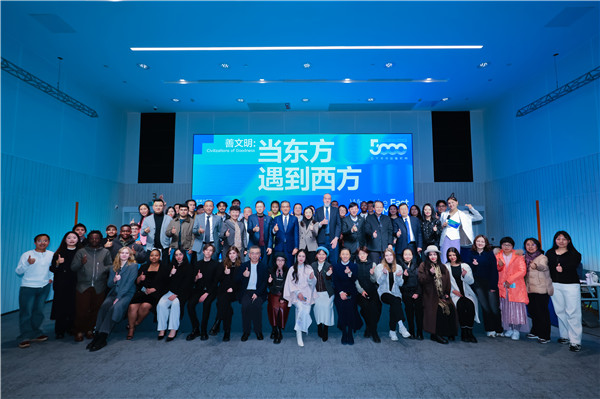
Participants in the event get together for a group photo.
-
Visionary Pathway - Hangzhou Playbook
July 15, 2025