

From Liangzhu to world: Journey of civilizational dialogue
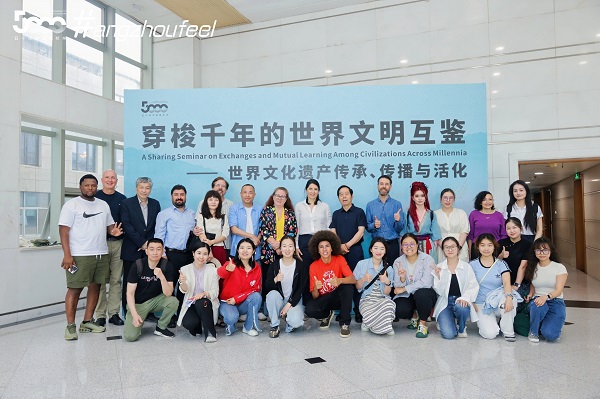
Visitors get together for a group photo.
On June 11, a group of 10 international "Hangzhou Seekers" gathered with cultural experts to embark on a journey across time, cultures and civilizations. They were joined by researchers from the Liangzhu Museum.
The guests — from Greece, Turkiye, Brazil, Canada and beyond — shared personal stories and cultural insights in a vivid seminar entitled "Exchanges and Mutual Learning Among Civilizations Across Millennia."
The dialogue began where it all started — with Liangzhu.
The seminar illuminated how Liangzhu's ancient legacy continues to resonate even to this day.
According to Wang Jiadian, head of the cultural relics conservation department at the Liangzhu Museum (the Liangzhu Research Institute), the Liangzhu Civilization holds not only historical and academic significance, but also vitality in education and cultural innovation.
In her presentation, she detailed Liangzhu's cultural evolution and how its legacy had entered modern life through creative education programs like Liangzhu fairytales and cultural products that are designed to spark public interest and recognition.
The theme of common humanity resonated throughout the day. Brazilian lawyer Renato Freitas spoke of the Capoeira — a Brazilian form of dance and martial arts — as a way to express cultural identity and foster community inclusion. Thai musical conductor Kittiporn Tantrarungroj highlighted how music bridged tradition, as he sought out harmony between Western classical and Thai folk traditions.
Elsewhere, journalist Tunc Akkoc from Turkiye described his country as a bridge between East and West, with millennia-old settlements like the Gobekli Tepe archeological site standing as testimony to a rich, convergent heritage. Meanwhile, Italian documentary filmmaker Leonardo Lombroso reflected on how universal emotions like love shape both Western and Chinese tales — from Shakespeare's play Romeo and Juliet to The Legend of the White Snake. "Love is a timeless theme that connects us all," he said.
Likewise, participants from Egypt, Spain, Germany, the US and Canada added their own perspectives.
Egyptian curator Remonda Zaki said that the Grand Egyptian Museum will open in 2025 as a dynamic space for both learning and legacy. Francisca Molinero, principal of a Spanish international school, noted how centuries of cross-cultural exchanges have shaped Spain into a true melting pot of traditions. German photographer Gunther Riehle celebrated the precision, discipline and beauty embedded in Germany's heritage — from cuckoo clocks to Gothic cathedrals.
American historian David Miano offered perhaps the most powerful metaphor: the pyramids. In ancient China, Mesoamerica, Mesopotamia and Egypt, he said, the pyramids reflected humanity's shared awe of the cosmos, divinity and mortality.
"Civilizations independently built similar monuments to mark power and the sacred — this shows how deeply alike we are in our existential quests," he explained.
For Canadian content creator Angelina Zhang, cultural diversity is lived every day — in language, food and in sport. "Whether it's maple syrup, poutine, or indigenous art, these are all daily expressions of who we are as Canadians," she added.
The seminar concluded with reflections from local Chinese students, who affirmed the importance of openness to cultures and storytelling. Through shared memories, songs and symbols, the journey was said to prove one essential truth: Despite differences, civilizations are more interconnected than we realize. And from Liangzhu's ancient spirit to today's global exchanges, the story of humanity continues — together.
-
Visionary Pathway - Hangzhou Playbook
July 15, 2025