

A Gen Z Grand Canal experience: Where culture meets technology
On July 9, the banks of the Grand Canal and the foot of Gongchen Bridge welcomed some special visitors. Answering the call of "Hangzhou, A Window to China's 5,000 Year Civilization", the Gen Z contestants of the 2025 "Chinese Bridge" Global Chinese Proficiency Competition stepped into the heart of the canal. There, they enjoyed a moving cultural feast, surrounded by the soft splash of oars and shimmering reflections on the water.
Jointly hosted by the Hangzhou International Communication Center and Hangzhou Dianzi University, the event invited international youth to explore thousands of years of Chinese history, technology, and culture through the lens of the Grand Canal.
Discovering Chinese civilization in ancient Grand Canal
In June 2014, China's Grand Canal, the world's oldest, longest-operating, and largest-spanned man-made canal, was added to the World Cultural Heritage list. From Gongchen Bridge, the southern end of the Beijing-Hangzhou Grand Canal, a vivid contrast comes into view: A modern skyline to the east and a historic block with whitewashed walls and black-tiled roofs to the west — a dynamic blend of tradition and modernity.
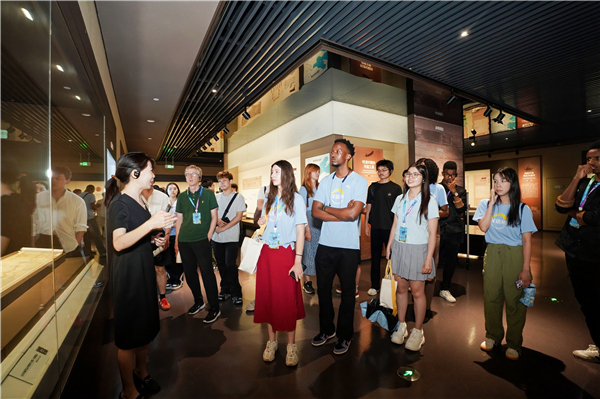
Contestants visit the Grand Canal Museum.
Inside the entrance hall of the Grand Canal Museum, located just east of the bridge, a sweeping audiovisual display brings the canal's story to life. Contestants from the competition took on the role of sailors, setting off as a "northbound canal fleet" from Hangzhou's Gongchen Bridge, journeying along the Grand Canal all the way to Beijing. The passing landscapes and shifting seasons left an impression spanning millennia. One contestant from Egypt, reflecting on her homeland's Suez Canal, remarked, "Both Egypt and China have rich histories. I never imagined these two ancient civilizations had so much in common in canal-building."
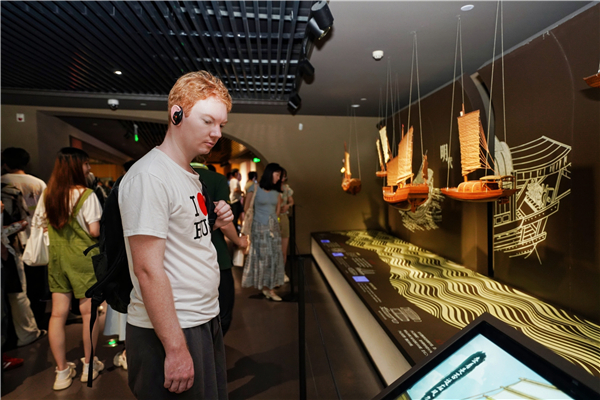
Contestants explore canal vessels of various shapes and styles across dynasties.
"It was the first time I learned that the Grand Canal's water source isn't Beijing or Hangzhou, but somewhere in between," said Cao Qiuhui, an Indonesian student at Nankai University, intrigued by a cross-sectional model of the canal. "I had no idea locks were used to adjust the elevation for navigation!" Coming from Indonesia, a country with a tropical rainforest climate and abundant water, Cao found the museum's exhibits on ancient rainwater harvesting techniques and the modern South-to-North Water Diversion Project especially fascinating. "Even by today's standards, the water management systems are truly impressive."
Unveiling the Canal's innovation through 3D printing and Peking Opera
From the ingenuity of ancient canals to the forefront of modern technology, all it takes is a 3D printer.
At the Grand Canal Red Sandalwood Museum, Professor Shen Guoqiang from Hangzhou Dianzi University's School of Mechanical Engineering showcased cutting-edge 3D printing technology, with a 3D printer emitting a flashing blue light. International youth eagerly passed around a vibrant, interlocking Chinese dragon and a pair of flexible running shoes that comfortably fit size 40 feet.
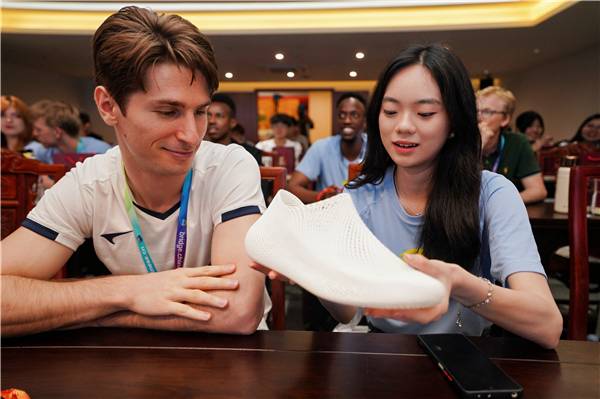
Contestants check out 3D-printed sneakers.
In just 60 seconds, international youth could have their chosen 3D photo printed onto a palm-sized "leaf". Professor Shen explained that applying 3D printing technology to cultural relic restoration offers restorers a powerful new tool and opens exciting avenues for digitizing cultural heritage.
Zhang Kewei, a student from Hangzhou Dianzi University and an avid fan of Peking Opera, performed a beautiful excerpt from The Jewelry Purse, earning warm applause from the audience. Zhenbao, a contestant from Egypt, followed with a stirring piece from the Henan Opera Mulan, vividly capturing Mulan's bravery and spirit through her expressive vocals and movements.
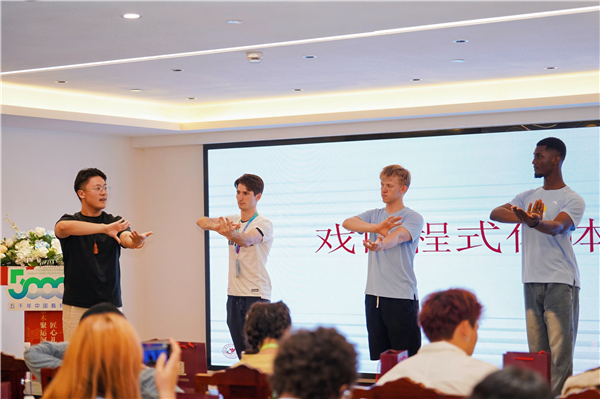
Contestants learn stage movements of Peking Opera.
Zhang Kewei explained, "When the Huiju Opera troupes journeyed to Beijing, the early forms of Peking Opera from the south moved north along the canal to perform in the capital. The canal acted as a cultural bridge between north and south." He then invited six international youths on stage to learn the steps and movements of Chinese opera. With his patient guidance and a bit of practice, they gradually picked up the bold, sweeping "mountain arms", the elegant finesse of "orchid fingers", and the fluid grace of "cloud hands".
-
Xi Story: West Lake and beyond
August 6, 2025
-
Nine Hangzhou-based companies make Fortune Global 500 list
July 30, 2025
-
City built on water: Hangzhou's wetland legacy goes global
July 25, 2025
-
Visionary Pathway - Hangzhou Playbook
July 15, 2025