

Tailored fitness delivered to your door
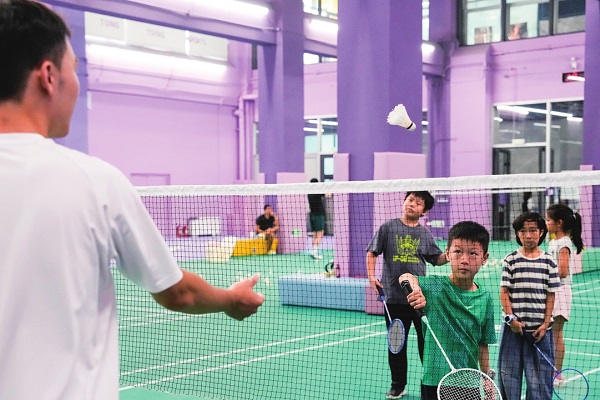
Children play badminton in a gym in Beijing on July 22. Photos: VCG
The doorbell rings - not announcing the arrival of dumplings, but a coach in sneakers, a duffel bag slung over one shoulder, and a mini hurdle tucked under one arm. In this new twist on delivery culture, the "order" isn't dinner - it's a doorstep sports class.
Known as "sports delivery," the service has recently caught on among families with children and teenagers across China. The idea is simple yet appealing: Book a session through your phone, and a professional coach will show up with the right gear, ready to lead a customized workout tailored to the child's needs. Whether it's boosting fitness, sharpening exam day skills, or simply making exercise more fun. Flexible, personal, and convenient, this sporty "takeout" is gradually finding its way into more households.
Mumu, a coach with a Beijing-based youth sports training center, told the Global Times on Tuesday that the number of bookings during the summer holidays has seen a noticeable increase this year, with many customers being students preparing for the physical education test in the secondary school entrance examination.
"At present, each instructor teaches about five one-hour classes per day, with one class costing 350 yuan ($49). The class takes place at an open space near the student's home," said Mumu.
For a female student in Beijing, the physical test for secondary school entrance exam contains a mandatory 800-meter run and some optional events such as sit-ups, long jump, basketball or badminton.
Wang Peng, an associate research fellow at the Beijing Academy of Social Sciences, told the Global Times that "sports delivery" meets personalized needs while offering convenience.
It allows courses to be tailored on demand, for example, designing specialized training for a child whose basketball skills need work but who has strong overall fitness, helping to unlock athletic potential and avoid the one-size-fits-all approach of traditional training, Wang said.
Great potential
When Li Wangqiang started out as an ordinary fitness coach in East China's Fujian Province, he never imagined he would one day be carrying kettlebells and foldable cones into apartment courtyards instead of working in a gym. By 2021, he had begun to see that 70 percent of gym memberships were basically idle, he told the Global Times. "People kept signing up, but they rarely showed up. Most said they didn't have time or just didn't feel like going out."
At the same time, he was hearing a similar complaint from parents.
"Often, just picking up and dropping off a child can take more than two hours," Li said.
"The entire weekend could vanish due to traffic."
That gap between intention and reality gave rise to an idea: If meals could be delivered door to door, why couldn't fitness? In 2022, he got his first real opportunity to materialize the idea, when 20 IT practitioners hired his team for a two-hour team-building workout. It cost the clients less than renting a venue, and brought in more profit per hour for the coach.
When the participants began posting photos online, the requests started coming in. Soon, with the growing demand for customized health services, Li had transitioned into a provider of what's now called "sports delivery."
According to Li, demand peaks during the summer holidays, with children and teens preparing for physical exams often training up to three times a week.
For one high school senior he taught - a dance student preparing for the entrance exams at a top arts university - Li created a three-month plan for her, squeezing in just 30 to 40 minutes a day between her other commitments and finally helping her pass.
Coaches provide door to door instruction with flexible scheduling, saving time and energy for both parents and children, which is especially convenient for families with busy, unpredictable work schedules, Wang noted.
The continued popularity of "sports delivery" is, in fact, a microcosm of the booming door-to-door service sector, which includes services such as pet feeding at home, private cooking at home, and bathing assistance for the elderly.
According to iiMedia Research Institute, with China's O2O (online-to-offline) market surpassing 2.7 trillion yuan in 2023 and more than half of that from at-home services, analysts expect that the total market size is expected to exceed 5 trillion yuan by 2027.
"This is a natural extension of the personalization era," Zhang Yi, CEO of the institute, told the Global Times. "But to thrive, the industry must build trust, improve quality, and create stronger accountability mechanisms."
Tightening oversight
The rapid rise of this new service model inevitably raises questions about industry standards. For all its novelty and convenience, "sports delivery" is not without its growing pains. Service quality can vary widely from one provider to another, leaving parents unsure of the training their children will receive.
Disputes over fees or unsatisfactory sessions can be hard to resolve, as clear channels for consumer protection are still lacking.
A resident surnamed Wang in Hangzhou, East China's Zhejiang Province, booked a home jump-rope class for her child, but because the coach failed to correct the child's posture, it resulted in a knee injury, Zhejiang-based media outlet Qianjiang Evening News reported in July.
As demand continues to climb, finding the right balance between innovation and oversight will be the key to sustaining the healthy growth of the service.
Due to inadequate market oversight, some coaches lack professional qualifications and teaching experience, and poorly designed courses may increase the risk of injury. The quality and safety of equipment are also difficult to guarantee. Additionally, the cost of providing door to door services can make "sports delivery" relatively expensive, Wang said.
The new business model can broaden employment opportunities for young people, but it is necessary to regulate the market by requiring coaches to hold relevant professional certificates. Raising service quality standards by formulating guidelines covering course content, duration, and equipment safety, should be coupled with regular inspections and evaluations, and imposing penalties on those who violate the rules, he added.
-

Echoes of Romance from East to West
August 12, 2025
-
Nine Hangzhou-based companies make Fortune Global 500 list
July 30, 2025
-
City built on water: Hangzhou's wetland legacy goes global
July 25, 2025
-
Visionary Pathway - Hangzhou Playbook
July 15, 2025