

Cultural heritage uniting people's identity
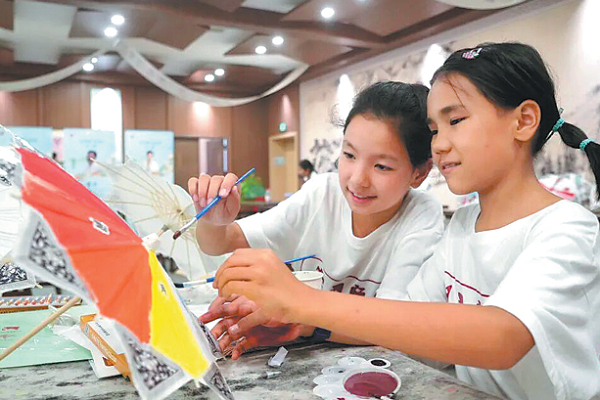
Children draw on a paper umbrella at a cultural exchange event to discover Hangzhou of Zhejiang province and depict the Silk Road. CHINA DAILY
Outreach programs and schools playing a role in enriching communities through the power of art
Residents of Nurbag community in the city of Aksu in the Xinjiang Uygur autonomous region recently enjoyed a special performance in their neighborhood by the Urumqi Qin Opera Troupe.
The event, part of a cultural outreach program to bring performances to communities, featured singing and acting that showcased the charm of traditional Chinese opera.
"I had only watched opera on television before — it was a surprise to experience such a high-quality show right here in our community. It allowed us to appreciate the beauty of traditional Chinese culture and added richness to our daily lives," said Mayira Tursun, an audience member.
In recent years, Aksu has focused on fostering a strong sense of community for the Chinese nation, intensifying efforts to enrich Xinjiang with a vibrant culture. By innovating communication platforms, diversifying activities and deepening educational practices, the city has nurtured a deeper connection between outstanding traditional Chinese culture and the frontier region, allowing it to take root and resonate among the people.
Modern showcase
As a central platform for cultural development in Xinjiang, the Aksu Traditional Chinese Culture Academy is a modern showcase of this heritage. Occupying more than 5,000 square meters, the academy features a traditional Chinese architectural style and is structured around the four classical categories of literature: classics, history, philosophy and belles-lettres. The academy houses a traditional Chinese culture exhibition hall, a study room, functional spaces, an outdoor corridor and a statue of Confucius. With a collection of 14,000 books covering classical Chinese texts, poetry and literary works, it also incorporates a dedicated resting place for sanitation workers, tourists and other visitors.
A series of cultural events have recently brought a vibrant energy to the academy. These included traditional cultural experiences centered on the rhythm of the solar terms, a cultural exchange event for children to discover Hangzhou of Zhejiang province and depict the Silk Road, and a large-scale reading event to mark the 2,576th anniversary of Confucius' birth.
At the events, attendees from various ethnic groups dressed in traditional attire, immersing themselves in the rich atmosphere of ritual, music and literature. These designed experiences blended the wisdom of the solar terms with artistic beauty, offering the public a feast of culture. Through participation and creativity, residents gained a deeper, more tangible connection to the profound charm of China's traditional heritage.
In 2025, following the principle of integrating dynamic engagement with reflective learning and combining theory with practice, the academy designed three dedicated sections of a cultural exhibition zone, an interactive experience zone and a demonstration and performance zone.
The academy showcased intangible cultural heritage works such as embroidery, Peking Opera masks, and paper-cutting. It also organized hands-on activities such as the creation of lacquered fans, DIY tea-leaf picture frames, the traditional game of touhu (pitch-pot), and tea-whisking techniques. Furthermore, the academy conducted over 130 popular national iconic cultural events, including lectures on traditional Chinese thought, classical text readings, and gatherings centered on poetry, calligraphy, painting and tea. These activities attracted more than 5,800 participants, making the academy a model for cultural heritage in Aksu.
Wangsan Street, a renowned hub of ethnic unity in Aksu, underwent an upgrade and renovation starting in May. The project involved the installation of underground pipelines, repaving roads, and the refurbishment of shop facades. Throughout the renovation, the neighborhood implemented communication measures to minimize disruption for businesses and residents. Efforts were also made to preserve and promote the street's historical legacy, complemented by the creation and discussion of the novel Wangsan Street, building a cultural brand that connects "a book, a street and a city".
Following a dedicated seminar in Beijing that gathered experts to discuss the contemporary significance of the work in Wangsan Street, the project gained momentum for its cultural mission.
The renovated street now maintains the bustling, lived-in feel and historical texture of the old city, complemented with modern infrastructure and an immersive cultural environment.
During the National Day holiday, Wangsan Street Cultural Block attracted tourists from across China. Visitors were observed purchasing local specialties such as dried fruits and snacks, as well as cultural and creative products from various stores.
The upgrade project for Wangsan Street focused on three key objectives of functional enhancement, cultural enrichment, and public benefit.
Key infrastructure work included upgrading underground pipelines and road surfaces to resolve issues with water, heating, and gas supply, as well as an uneven pavement. The project involved installing new streetlights and signage, and standardizing shop frontages, improving the street's functionality and aesthetic appeal.
"Wangsan Street has always been a high-traffic area. After the renovation, we have more public facilities, better scenery, and smoother roads, which offer a much better experience for tourists," said Amangul Tohniyaz, a resident of Aksu.
Holistic education
By integrating traditional Chinese culture into the classroom, Aksu is using culture to nurture the hearts and minds of its youth. Recent school activities, ranging from group readings of classics to intangible cultural heritage craft workshops, are fostering a deeper connection with Chinese heritage and providing students with a strong foundation for growth.
Aksu has incorporated traditional Chinese learning into the local education system, bringing it into classes, integrating with curricula, and deepening students' understanding of traditional Chinese learning and strengthening their cultural identity.
For instance, the Aksu No 17 Middle School pioneered a Qin-Han dynasties (221 BC-AD 220) themed singing and dancing festival, blending ancient games such as touhu and bamboo slip calligraphy with digital technology to create immersive cultural experiences.
Meanwhile, Aksu Tianhang Experimental School held its fifth Flower Birthday Festival and Pomegranate Blossom Art Festival. The events gathered students, parents and teachers to appreciate traditional culture through dialogues. The school also established an opera master's studio to promote traditional arts on campus.
In addition, schools have launched 109 student clubs dedicated to traditions like calligraphy and paper-cutting, while incorporating classics such as The Analects of Confucius and The Book of Songs into formal curricula. A series of activities aimed at promoting traditional Chinese culture learning and inheriting classics have been carried out, enriching ideological education and fostering cultural confidence and patriotic sentiment among youth.
"It was my first time taking part in the entire flower festival tradition — admiring the flowers, watching the performances, and experiencing the folk customs. I could really feel the unique charm of our culture," said Xayida Turhon, a student dressed in traditional Han clothing.
Aksu's schools also offer students a variety of cultural activities to deepen their connection with traditional arts.
For example, paper-cutting artist Zhou Rui and her students recently guided participants in creating intricate patterns such as pomegranate blossoms, with each piece symbolizing ethnic unity. Additionally, calligrapher He Yang led students in writing classical poetry, helping them perceive the aesthetic beauty of Chinese characters and reflect on the cultural spirit of self-cultivation.
"In today's rapidly evolving society, the fields of culture and technology continue to diversify. For students, it is essential to pursue well-rounded development in moral, intellectual, physical, aesthetic, and labor education, while also inheriting and promoting China's outstanding traditional culture," said Kong Zhaoli, Party secretary of Aksu Tianhang Experimental School.
Living legacy
On the evening of Oct 18, the original song-and-poem performance Oasis Feast — Qorikum Maxrap was staged at a local theater. As a national-level intangible cultural heritage piece, it presented a brilliant show that embodies a century-old legacy.
Qorikum, which means water in the desert, originated in Kartal town, Aksu. Listed as a national intangible cultural heritage item since 2008, it is not just a comprehensive art form integrating music, dance, poetry and games, but a testament to the creativity of the Aksu people within the broader Chinese cultural context.
"The performance was brilliant, full of contemporary energy and ethnic character — it was truly impressive. Not only did I get to experience the charm of Maxrap up close, but I also gained a deeper understanding of Aksu," said audience member Amira Amat.
To promote cultural exchanges and mutual learning among all ethnic groups, the Aksu Kummaxrap Art Troupe held a special performance at Hangzhou Redstar Theatre on Nov 5, allowing audiences in Hangzhou to experience the charm of Xinjiang's intangible cultural heritage firsthand.
During the 2025 "Xinjiang is a Wonderful Place" cultural assistance event, Aksu presented 27 intangible cultural heritage items, including Kalpin embroidery and Kuqa folk instrument making, in a special exhibition held in Hotan. More than 3,000 heritage and cultural innovation exhibits attracted widespread attention.
Inheritors of these traditions demonstrated their skills on-site, where the classic charm of Kalpin embroidery and the contemporary creativity of cultural derivative products were well received.
Efforts will be made to better connect inheritors with market opportunities, ensuring that Aksu's intangible heritage remains not only alive in tradition but vibrant in everyday life, said an official from the Aksu bureau of culture, sports, radio, television and tourism.
More activities have also taken place. In the urban bookstore of Sahpaq village, Eganqi town in Aksu, retired teacher Patigul Aisa led children in a recitation of classical Chinese poetry. The children recited the poem Min Nong, which means sympathy for farmers, in Mandarin. They also created silk patchwork art using Atlas silk to depict the poem's scene of farmers "hoeing crops under the midday sun".
Meanwhile, Xincheng Street organized an intangible cultural heritage handicraft event for the Qixi Festival, where young people learned the arts of lacquer fan-making and tie-dyeing. "Each tie-dye piece is unique. Through creating, we truly felt the charm of traditional culture," said participant Hu Lijun.
Each year, such activities are held about 150 times, engaging over 200,000 residents, local officials said.
Aksu has adopted a multidimensional approach to strengthening the social fabric through cultural development. By establishing cultural centers, integrating traditions into education, and preserving intangible heritage, the city has rooted Chinese cultural traditions in local communities. These efforts enhance the role of culture as a force for unity, providing momentum for Aksu's continued development.
-

Hangzhou launches preparations for 5th Global Digital Trade Expo
November 6, 2025
-
Hangzhou Marathon champion decided by milliseconds
November 3, 2025
-
Hangzhou Botanical Garden unveils splendor of autumn chrysanthemums
October 30, 2025
-
International visitors find resonance at Liangzhu site
October 20, 2025