
A glimpse into Hangzhou
History
One of the birthplaces of Chinese civilization and ranking among the seven ancient capitals in China, Hangzhou stands out as the "Famous Town of Southeast China". The excavation of the Kuahu Bridge site located in the city's Xiaoshan district indicates that as early as 8,000 years ago the place already saw thriving human activities. The 5,000 year-old Liangzhu culture is hailed by historians as "the dawn of civilization". First set up as a county in the Qin Dynasty (221-206 BC), Liangzhu has a past of over 2,200 years. In the 9th year of Emperor Yang Jian, founder of the Sui Dynasty (581-618), the old Qiantang County (today's Hangzhou) was abolished and replaced by Hangzhou (Hang prefecture), marking the first appearance of its current name. Hangzhou was a marvel to 13th century Italian traveler Marco Polo who called it "the most graceful and splendid city of the world".
Economy
The GDP of Hangzhou increased by 5.2 percent in 2025, exceeding 2.30 trillion yuan ($330.45 billion), according to data released by the municipal statistics bureau on Jan 22.
The growth rate was 0.2 percentage points higher than the national average, reflecting a stable and improving economic performance driven by high-quality development and new growth drivers.
By sector, the primary industry added 38.3 billion yuan, up 3.8 percent; the secondary industry rose 5.0 percent to 563.1 billion yuan; and the tertiary industry increased 5.3 percent to 1.70 trillion yuan. The industrial structure stood at 1.7:24.5:73.8.
Emerging industries and services also continued to play a key role, while residents' incomes rose steadily. In 2025, per capita disposable income reached 80,017 yuan, up 4.2 percent, with the urban-rural income gap further narrowing.
Culture
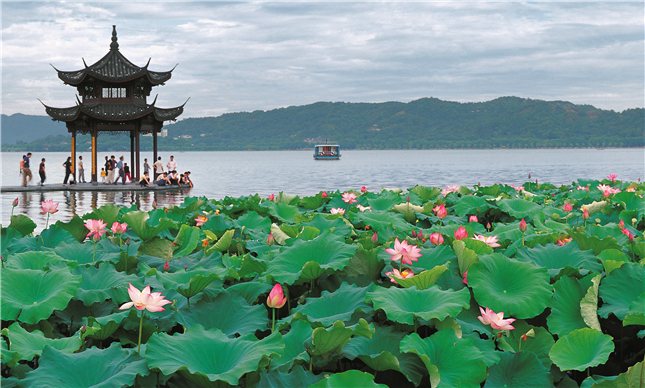
Hangzhou boasts a long history and great cultural wealth. Its culture features the landmarks of the city, like West Lake, the Grand Canal and the Qiantang River and embraces integration and development in an open and innovative era.
The West Lake Culture absorbed the essence of local culture in different epochs, such as Kuahuqiao Culture, Liangzhu Culture that dates back to 3310 - 2250 BC, Wuyue Culture, and the cultures of the Southern Dynasty (1127-1279), Ming and Qing dynasties (1368-1644, 1644-1911) and the Minguo era (1912-1949).
West Lake Culture covers a wide range of elements, including landscape, gardening, religion, architecture, celebrities, folk customs, the Silk Road, tea and cuisine, all coming together in delicacy and harmony.
The Canal Culture, which integrates the specialties, waterscape, local opera and temple fairs, shows the openness, inclusiveness and popularity of Hangzhou Culture.
Qiantangjiang Culture is as magnificent as the tidal bore of the Qiantang River.
Geography & Climate
As the capital of Zhejiang province and its economic, cultural, science and educational center, Hangzhou is one of the central cities in the Yangtze River Delta. It also ranks among the first batch of National Historical and Cultural Towns crowned by the State Council.
Located in the southern wing of the Yangtze River Delta, at the western tip of Hangzhou Bay, it is the crossing point of the extension of the Silk Road Economic Belt and the 21st Century Maritime Silk Road, and a strategic hub along the Online Silk Road. Situated at the juncture of 29°11'-30°34' North and 118°20'-120°37' East, Hangzhou features a perfect blending of hills and water, and lakes and town, with its harmonious rich water resources of rivers, canals, lakes, sea, creeks. Hilly or mountain areas, largely concentrated in the west, middle and south, account for 65.6 percent of its territory. Its plains amount to 26.4 percent, mainly found in the northeast; and the surface area of rivers, lakes and reservoirs takes up 8.0 percent. Hangzhou boasts the largest reservoir in China's southern coast — Qiandao Lake. Traversing the city is the world's longest artificial canal — the Beijing-Hangzhou Grand Canal, and the Qiantang River, widely known for its spectacular tidal waves.
Hangzhou enjoys a subtropical monsoon climate with distinct seasons, ample sunlight and rainfall, more in spring and autumn and less in winter and summer.
Administrative Division
Under the jurisdiction of the city of Hangzhou are 10 urban districts, namely Shangcheng, Gongshu, Xihu (West Lake), Binjiang, Xiaoshan, Yuhang, Linping, Qiantang, Fuyang, and Lin'an, one county-level city — Jiande — and the two counties of Tonglu, and Chun'an. The city covers a total area of 16,596 square kilometers; 4,876 of them are urban.
-

Global open-source AI Challenge launches in Hangzhou
July 22, 2026
-
Zhejiang's cultural legacy helps bring 'world's largest encyclopedia' home
July 9, 2026
-
Embrace the future
July 6, 2026