

NEVs grab over 60% of deliveries in July
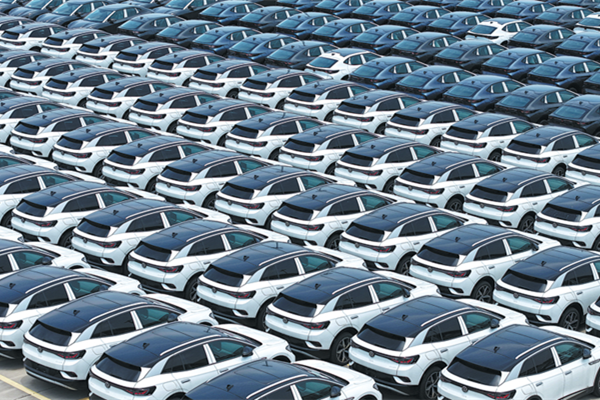
China-produced new energy vehicles are lined up for export at an international auto trade port in Hangzhou, Zhejiang province, on Aug 12. LONG WEI/FOR CHINA DAILY
For the first time, China's new energy vehicles secured a more than 60 percent share of the country's overall automobile sales in July, under full-sector official statistics.
The milestone, paired with sustained record automotive exports, marks a decisive shift toward market-driven electrification at home and elevates China's role as a key driver of global automotive growth.
A total of 1.56 million NEVs were sold in July, up 23.7 percent year-on-year, according to the China Association of Automobile Manufacturers.
They accounted for 60.4 percent of new passenger and commercial vehicles delivered in July.
Total NEV sales hit 9 million units in the first seven months, rising 9.6 percent year-on-year. Cumulatively from January to July, NEV penetration exceeded 51.2 percent.
The continuous rise in NEV penetration was the result of a combination of factors, said analysts. They said electric cars now boast markedly lower energy expenses, pushing mainstream households to switch to new energy options for long-term economic benefits.
Domestic automakers have enriched full-range product portfolios, covering affordable urban runabouts, family SUVs and premium intelligent vehicles.
Continuous upgrades in battery endurance, fast charging and smart cockpit systems have largely erased consumers' range anxiety. To aid their daily use, China has built the world's largest network of charging piles and battery swapping stations across cities and rural areas.
Parallel to the domestic structural overhaul, China's automotive exports have sustained robust long-term growth momentum. Total vehicle exports reached 1.043 million units in July, the second consecutive month exceeding the 1-million mark with an 81.3 percent year-on-year increase.
NEV exports hit 553,000 units, jumping 145.5 percent year-on-year and accounting for more than half of total outbound shipments for two straight months.
"The domestic market features weak internal demand yet buoyant overseas trade. Exports have become the key stabilizer and primary growth driver for the entire automobile sector," said Chen Shihua, deputy secretary-general of the CAAM.
Cumulative auto exports from January to July totaled 6.14 million units, among which NEV shipments reached 2.91 million units, more than doubling year-on-year.
Chinese automakers have upgraded their overseas strategy from finished vehicle sales to a systematic industrial ecosystem layout. For example, GAC Aion has built dedicated spare parts warehouses in Britain to shorten overseas after-sales waiting times. Also, Chery launched localized new energy brands and manufacturing bases in Egypt to adapt to North African road conditions and uneven charging infrastructure.
Beyond passenger vehicles, China exports industrial solutions including battery manufacturing, high-power charging networks, after-sales services and smart mobility systems to Europe, Southeast Asia and the Middle East.
Cui Dongshu, secretary-general of the China Passenger Car Association, interpreted the upgraded global layout based on long-term export monitoring statistics.
"Chinese carmakers no longer treat overseas expansion as a supplementary channel to ease fierce domestic price competition," said Cui.
"The industry is shifting focus from exporting individual cars to delivering customized industrial systems compatible with varied regional regulations and consumer demands across the globe," Cui noted.
The rapid expansion of Chinese NEVs has sparked reactions within the global automotive industry, embodying intertwined competition and cross-border collaboration.
Established European and US automakers face mounting pressure after decades of concentration on internal combustion engine technology research and production.
Chinese brands secured 16.3 percent of Western Europe's NEV market share in July, a sharp rise from 9.2 percent one year earlier.
Multinational automakers are utilizing China's sophisticated industrial chain to lower R&D and manufacturing costs and adjust cockpit functions to fit local driving habits.
Volkswagen, BMW and Stellantis have expanded localized research centers and joint ventures in China to accelerate their own electrification transitions.
Volkswagen runs its largest overseas R&D hub in Hefei, Anhui province. It cuts vehicle development cycles by nearly 30 percent by leveraging China's massive real-world road data and intelligent driving ecosystem.
GAC Honda said it is now shifting from "global models adapted for China" to "China-defined products", allowing local teams to play a greater role in vehicle development.
"Those who live and drive in China every day should define the vehicles Chinese consumers use every day," the company said.
GAC Honda plans to introduce a "product director system" under which teams from the joint venture will lead product definition and coordinate resources from both shareholders.
Yet China's NEV industry still faces challenges. The sector is transitioning from blind scale expansion to refined technological competition amid prolonged price wars.
Chinese carmakers' overseas operations must navigate fragmented emission codes, inconsistent charging protocols and diverse consumer preferences across continents.
Chen said the dual milestones of 60 percent comprehensive NEV penetration and monthly million-unit exports have placed China's automotive industry at a new crossroads.
China's auto industry will press ahead with domestic industrial upgrading, conduct fair global competition and deepen cross-border technological collaboration to advance worldwide transportation carbon neutrality, he said.
lifusheng@chinadaily.com.cn
-

Robots stepping into real world in Zhejiang
July 31, 2026