

Humanizing the future of robotics
During my visit to the 2024 World Manufacturing Convention in Hefei, East China's Anhui province, I felt as though I had stepped into a scene from a science fiction movie. Before me, a 1.8-meter-tall humanoid robot weighing 60 kilograms was using its 38 degrees of freedom — or 38 independent ways to move or rotate — to fold clothes, open bottles, pour water and wash dishes with remarkable precision.
Since then, the race to develop more advanced robots has only gained momentum.
Improvements in actuators and sensors now allow humanoid robots to walk, run and perform increasingly complex tasks. At the same time, advances in artificial intelligence are rapidly enhancing their ability to interpret surroundings, interact with people and adapt to changing situations.
Applications now extend far beyond the factory floor. Humanoid robots are now finding roles in agriculture, customer service and healthcare, as well as in assisting older people, patients and persons with disabilities.
However, humanoids are only part of a much broader transformation.
Collaborative robots, or cobots, work alongside people, augmenting human capabilities in factories, laboratories and hospitals. Swarm robotics enables multiple robots to coordinate on tasks such as searching for and rescuing survivors, inspecting infrastructure or exploring hazardous environments.
This new generation of robots is pushing the boundaries of possibilities. But perhaps the more important question is not what robots will eventually be capable of, but what we want them to do.
As the father of a young man with an intellectual disability caused by a rare genetic condition, I have seen firsthand the extraordinary contributions of robotics and intelligent technologies to everyday life. They can help organize routines, facilitate communication, improve safety and enhance personal autonomy. For many families, these are not abstract possibilities, but tangible improvements in daily life.
This experience has also taught me an important distinction that no technological advance should blur: assistance and care are not the same thing. Machines can perform tasks with ever greater efficiency, but care requires recognition, responsibility, patience, empathy and affection. Those qualities arise essentially from human relationships, rather than from algorithms.
Therefore, the purpose of robotics in care should not be to replace human relationships, but to augment human capabilities, allowing caregivers, families and professionals to devote more time to the distinctly human dimensions of care.
As a development practitioner, I have learned that this principle extends far beyond healthcare and caregiving. I made this point recently at the Web Summit Rio: The greatest challenge posed by a new technology is not merely to develop it, but to transform technological progress into development.
International experience shows that countries do not prosper simply because they acquire advanced technologies. They progress when they build the institutions, human capabilities and productive structures needed to translate innovation into productivity, opportunity and greater well-being.
Similarly, robotics becomes a tool for development only when integrated with education, skills development, entrepreneurship, industrial capabilities, infrastructure and sound public policies that accompany technological change.
This is also one of the key lessons from China's remarkable advances in robotics.
What impressed me the most during my visit to Hefei was not only the sophistication of the machines, but also the ecosystem surrounding them — universities, research centers, manufacturers, digital infrastructure, supply chains and industrial policies evolving together. Robotics did not appear as an isolated technological achievement, but as part of a broader strategy for productive modernization.
This is an important lesson for developing countries.
The goal should not simply be to buy robots or imitate those leading the technological race. Instead, it should be to develop the capabilities needed for robotics to increase productivity, expand opportunities and promote more inclusive and sustainable development.
The same principle applies whether robots operate in factories, farms, hospitals or homes.
An industrial robot should not be judged simply by the number of workers it can replace, but by its ability to make production safer, more productive and more competitive. An agricultural robot should not be valued merely for automating harvesting, but for enabling us to produce more food with fewer resources and less environmental impact. And an assistive robot should not be considered successful because it mimics human interaction, but because it empowers a person with a disability to gain autonomy, allows an older person to live more independently, or enables a caregiver to devote more time to genuinely human care.
Robotics, perhaps more than many other emerging technologies, reminds us that innovation should never be an end in itself. Its true value lies in the human possibilities it creates.
Ultimately, the measure of technological progress will not be what robots can do, but what human beings can achieve because of them.
The author is former director-general of the United Nations Industrial Development Organization (UNIDO), former state secretary for industry of Argentina, and now a board member of several Latin American companies.
The views do not necessarily reflect those of China Daily.
If you have a specific expertise, or would like to share your thought about our stories, then send us your writings at opinion@chinadaily.com.cn, and comment@chinadaily.com.cn.

-
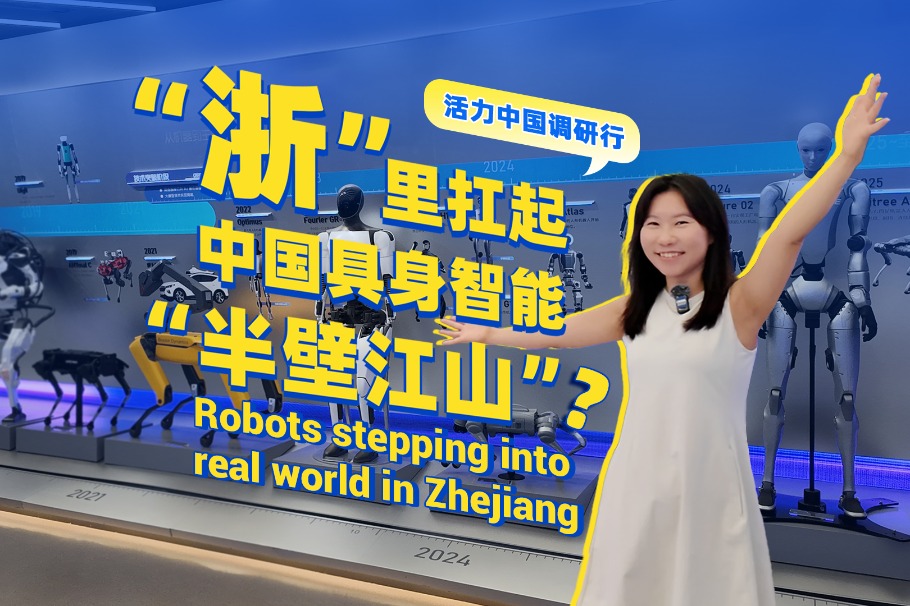
Robots stepping into real world in Zhejiang
July 31, 2026