

Hangzhou sees rise of AI-driven one-person companies
AI-powered one-person companies (OPCs) are taking off across China, as individuals use artificial intelligence (AI) tools to handle every stage of a business, from product design to market launch.
The number of OPC communities nationwide jumped from 95 to 618 in the first half of this year and now spans 24 provinces and 75 cities, according to the 2026 national OPC development observation report.
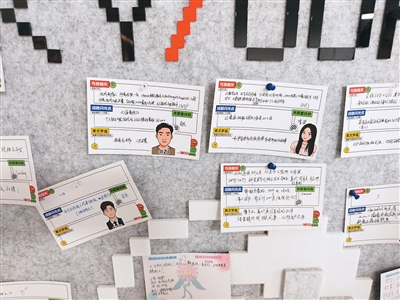
Entrepreneurs pin their information on an exhibition board at the ModelScope Developer Center in Hangzhou, East China's Zhejiang province. [Photo/People's Daily Overseas Edition]
Hangzhou, the capital of East China's Zhejiang province, is now home to more than 2,000 "AI+OPC" enterprises and more than 50 such communities.
At Honghub, an OPC community in Hangzhou's Shangcheng district, entrepreneurs work side by side at open desks, each running a company on their own.
"AI has bridged the skills gap, giving one person a skill set spanning copywriting, design and programming," said Li Yunfan, an entrepreneur in the community who led a software team before shifting to solo entrepreneurship.
His flagship product, an AI-powered essay-grading app, has attracted more than 15,000 users, who can photograph essays and receive automatic feedback. He is also developing a study-monitoring app.
"AI now handles 80 percent of the coding," Li said. "I'm the strategist, product manager and chief operating officer."
Since launching in September 2025, Honghub has incubated more than 50 "AI+" projects spanning finance, construction, education and health care. A 2026 report issued by Honghub found that 75 percent of OPC founders now come from non-technical backgrounds.
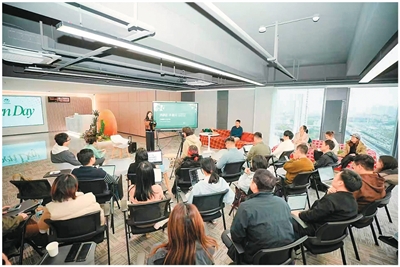
A sharing session takes place at Honghub, a one-person company community in Hangzhou, East China's Zhejiang province. [Photo courtesy of Honghub]
One such founder, Zeng Xiaofeng, was an IT consultant and solution architect before leaving his job last year without any coding experience.
In August last year, he took advantage of a developer incentive program under Chinese tech giant Huawei's HarmonyOS operating system, using AI tools to build his first app prototype in two weeks. He then completed a 20-hour HarmonyOS course and refined the app through repeated interactions with AI, eventually producing a fully functional product.
He has since developed an AI-powered smart hub device and is now testing a multi-agent collaborative management system.
"As AI has driven down the marginal cost of writing code, a technical background is no longer a prerequisite for starting a business. Industry knowledge, user insight and business judgment matter more," he said.

-
Robots stepping into real world in Zhejiang
July 31, 2026