

China expands its appeal to global business travelers
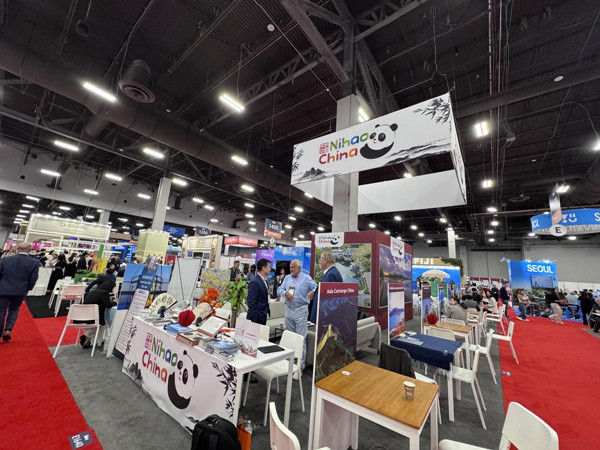
International buyers and exhibitors exchange information at the "Nihao! China" pavilion during IMEX America 2026 in Las Vegas, Nevada, on Oct 15, as China promotes its destinations for international meetings, incentive travel and business events. [Photo by RENA LI/chinadaily.com.cn]
Beyond convention halls, China offers new experiences, from cultural attractions and technology tours to cross-border business partnerships, as it seeks to attract more international meetings and incentive travel.
For international business travelers, a trip to China is no longer just about attending conferences or visiting factories. Increasingly, it is also an opportunity to explore the country's rich cultural heritage, experience its technological innovations and establish connections with one of the world's largest economies and consumer markets.
"International groups are not only interested in seeing a destination. They also want to understand how its businesses innovate, develop products and achieve growth," Bautista Vera Feld of WildChina, a company specializing in customized travel and corporate experiences, told China Daily.
"A well-designed company visit can turn that curiosity into a concrete exchange," he added.
That growing interest comes as China seeks to strengthen its position in the global meetings, incentives, conferences and exhibitions (MICE) industry, a market in which Europe and North America have long maintained influential professional networks and established convention destinations.
While Europe's international trade fairs have a history stretching back centuries, and the United States began developing specialized convention promotion organizations in the late 19th century, China's modern exhibition industry expanded rapidly following reform and opening-up in 1978.
The transformation has been substantial. According to the Global Association of the Exhibition Industry's 2026 World Map of Exhibition Venues report, China accounted for 30.7 percent of the world's gross indoor exhibition venue capacity at the end of 2025, compared with 13.9 percent for the United States and 7.0 percent for Germany.
Yet exhibition space tells only part of the story. The US and European countries continue to hold leading positions in attracting international association conferences, supported by established professional networks, event management services and long-standing relationships with international organizations.
For China, the next stage of development is not simply about constructing larger venues, but attracting more international participants and offering experiences that distinguish it from traditional meeting destinations.
At IMEX America 2026 from Oct 13 to 15, industry professionals told China Daily that easier visa access, improved transportation and growing international interest in China's technology sector are opening new opportunities for corporate meetings, incentive travel and professional exchanges.
"The infrastructure has improved dramatically over the last 30 years," said Alex Mortensen, Los Angeles-based sales director for HiSEAS International Tourism Group, citing China's high-speed rail network and expanding accommodation options.
Mortensen, whose company is headquartered in Chengdu, said cities such as Chengdu, Chongqing and Changsha are becoming increasingly attractive for international corporate events, offering modern facilities and opportunities for technology-related business exchanges.
Having traveled to China frequently over three decades, he said a recent family visit to Chengdu and Chongqing reinforced his enthusiasm for the country's tourism offerings.
China's efforts to attract international visitors have also been supported by expanded visa-free arrangements.
According to the National Immigration Administration, foreign nationals made 22.91 million inbound trips to China in the first half of 2026, up 20.4 percent year-on-year. Of those, 17.82 million were visa-free entries, an increase of 30.6 percent.
China has expanded visa-free entry arrangements for eligible travelers from countries including Australia, New Zealand, the United Kingdom, Brazil and Argentina, facilitating short-term visits for business and tourism. Eligible travelers from 57 countries, including the US, may also use China's 240-hour visa-free transit policy, provided they meet requirements for onward travel to a third country or region through designated entry ports.
For event organizers coordinating travel for international delegates, simpler entry procedures can reduce logistical difficulties and make China more competitive as a destination for business gatherings.
Linda Wang, director at Asia Concierge, a destination management company specializing in customized travel and corporate experiences, said the easing of entry requirements has contributed to increased business from overseas clients.
"We've seen a big increase in business," she said, referring particularly to travelers from Australia, New Zealand and the United Kingdom.
Wang also identified safety, competitive hospitality prices and the diversity of China's destinations as important advantages in attracting international incentive groups.
"Value for money is a big strength of China," she said.
She pointed to international luxury hotel brands including Peninsula, Mandarin Oriental, Capella and Aman, as well as boutique properties in western and northwestern China, as examples of the accommodation choices available to high-end travelers.
Wang said some luxury hotels in Beijing and Shanghai can be considerably less expensive than comparable properties in New York, although rates vary by location, season and property.
"Not many countries or destinations can compare with the variety of experiences we can offer," she said.
Technology adds a new dimension
Beyond traditional sightseeing, China's technological development is becoming an attraction for international corporate groups seeking firsthand exposure to emerging industries.
Wang said overseas clients are increasingly interested in visiting Hangzhou and Shenzhen, where they can learn about artificial intelligence, robotics and other technologies.
"They're interested in robotic experiences, smart restaurants, smart hotels," she said.
She cited hotels using service robots, restaurants experimenting with robotic chefs and technology-driven retail experiences as examples of activities that can be incorporated into corporate travel programs.
Such visits can give participants an opportunity to observe how emerging technologies are being applied in daily life, while combining business learning with leisure travel.
Feld of WildChina said international groups are also increasingly interested in visiting Chinese companies, factories, laboratories and innovation centers to understand the country's industrial development.
"The most significant evolution is that China's MICE offering is becoming more comprehensive: it is not simply about building impressive venues, but about bringing together the facilities, services and experiences that make an international event successful," he said.
Feld cited Beijing as an example, pointing to developments such as the second phase of the China National Convention Center and the Capital International Exhibition and Convention Center, supported by the city's airports, hotels and cultural attractions.
He said improvements in visitor services, including transportation assistance, communications, currency exchange and multilingual information, are also important to organizers managing large international groups.
"These may seem like small details, but for a planner managing hundreds of delegates, they make a difference," he said.
WildChina works with clients from the United States, Europe and emerging markets, including Latin America. Feld said its US clients have included consulting firms and executive groups interested in combining business exchanges with cultural experiences.
While corporate travel remains concentrated in Beijing, Shanghai, Shenzhen and Guangzhou, he said demand for more adventurous itineraries is also expanding to destinations such as Gansu, Xinjiang and Sichuan.
He believes China's combination of contemporary business development and cultural diversity gives it opportunities to compete with established meeting destinations in the US and Europe.
"China does not need to replicate Silicon Valley or established European destinations," Feld said. "Its opportunity is to offer a distinctive perspective that complements what international executives may already know."
But he cautioned that growing curiosity alone is not enough to secure international bookings.
Organizers need clear information about what a company visit will involve, which facilities participants can access and what they can expect to learn.
"Curiosity opens the door, but clarity and delivery secure the booking," he said.
Hong Kong connects the Greater Bay Area with the world
Hong Kong is seeking to strengthen its position as a gateway between international business communities and the Guangdong-Hong Kong-Macao Greater Bay Area, using conventions, corporate meetings and incentive travel to connect overseas organizations with mainland enterprises.
Marilyn Tham, general manager of mega events development and advancement at the Hong Kong Tourism Board, said the city is drawing on its international connections, established convention facilities and proximity to Chinese mainland business centers to attract more international events.
"We position ourselves as the MICE hub in the Greater Bay Area," Tham said.
Hong Kong welcomed 2.51 million MICE visitors in 2025, up 7 percent year-on-year, according to official figures. Of those, 1.43 million stayed overnight, generating approximately HK$10.7 billion ($1.37 billion) in visitor spending.
Tham said corporate meetings and incentive travel accounted for slightly more than 60 percent of MICE visitors, making them the city's largest segment.
Under the "Meet Hong Kong, Meet GBA" campaign, the tourism board is promoting the city as a base from which international organizers can access the Greater Bay Area's industrial, technological and commercial resources.
The Greater Bay Area encompasses Hong Kong, Macao and nine cities in Guangdong province, forming a regional market of more than 86 million people.
Tham pointed to companies including Tencent, BYD and Ping An Insurance as examples of major enterprises whose presence in the region creates opportunities for international organizers seeking corporate sponsorships, business partnerships and industry participation.
Transportation links are central to that strategy.
The Guangzhou-Shenzhen-Hong Kong Express Rail Link connects Hong Kong's West Kowloon Station with Shenzhen in less than 20 minutes and Guangzhou in less than 50 minutes, while the 55-kilometer Hong Kong-Zhuhai-Macao Bridge provides a direct road connection across the Pearl River estuary.
Tham said these links allow organizers to combine conferences in Hong Kong with factory visits, corporate exchanges and cultural excursions in neighboring mainland cities.
The strategy also works in the opposite direction.
As more mainland professional associations seek to introduce their expertise and industries to international audiences, Hong Kong can serve as a platform for building overseas connections.
"They always will take Hong Kong as a springboard for them, as a first stop to connect them with the world," Tham said.
The Hong Kong Convention Ambassador Programme supports those efforts through professional networks spanning finance, technology, medicine, law, aviation, transportation, arts and culture.
Tham said the program currently has about 170 ambassadors, including approximately 30 from the Chinese mainland.
She also reported an approximately 40 percent increase in convention participants during the first eight months of 2026 compared with the same period a year earlier.
Hong Kong is seeking to secure longer-term partnerships with international event organizers rather than relying solely on one-off conventions.
Among them is LEAP East, the Asian edition of a major technology event originating in Saudi Arabia, which made its Hong Kong debut in July.
The event attracted more than 25,000 participants, 55 percent of whom came from outside Hong Kong. The Hong Kong Tourism Board has secured an agreement for the city to remain its exclusive Asian host from 2027 through 2029.
Tham said such partnerships can strengthen Hong Kong's role as a regular meeting place for international technology companies, investors and industry professionals.
The city's technology sector is also attracting attention from overseas corporate event planners.
Vanina Damnotti, a project manager at Upper Agency in Argentina, which specializes in corporate events and experiential marketing, said her company sees opportunities to bring clients to Hong Kong.
"We have a lot of technology companies that are interested in Hong Kong," Damnotti said.
Vinicius Godinho Silva, an event agent with Sao Paulo-based Allmana in Brazil, also expressed interest in organizing corporate missions to Hong Kong, particularly for clients seeking exposure to emerging technologies and visits to leading technology companies.
For Tham, Hong Kong's competitive advantage lies in its ability to connect international business networks with the manufacturing, technological and commercial resources of the Greater Bay Area.
Turning international interest into business
For Chinese tourism businesses, international trade shows provide an important platform for developing relationships with overseas buyers and converting interest in China into future meetings and incentive travel programs.
Wu Dawei, director of the China National Tourist Office in Los Angeles, said Chinese exhibitors at IMEX America 2026 held extensive business discussions with international buyers, producing encouraging results.
According to Wu, several exhibitors secured expressions of interest in cooperation for 2027 and 2028, covering international conferences, incentive travel and business events in sectors including construction, finance and esports.
The prospective buyers came from countries including the United States, Canada, Brazil, Argentina and Germany.
"These cooperation intentions not only lay a solid foundation for the expansion of inbound MICE tourism to China over the next two years, but also reflect a broader trend," Wu said.
He described that trend as a shift toward more diverse source markets, increasingly specialized industry requirements and longer-term project partnerships.
Feld of WildChina said attending IMEX America is particularly valuable for developing relationships in Latin America and other markets where personal connections play an important role in business decisions.
He said face-to-face meetings allow companies to build trust and establish relationships that are difficult to develop through emails or telephone conversations alone.
The importance of personal exchanges also extends beyond commercial tourism.
Ulisses Araujo, a professor at the School of Arts, Sciences and Humanities at the University of Sao Paulo and president of the PAN-PBL association, which promotes problem-based and active learning methodologies, said conferences can help expand educational exchanges between Brazil and China.
"China is a place that everyone wants to know," Araujo said.
He said the University of Sao Paulo is offering a course about education in China taught by Chinese scholars, reflecting students' interest in learning more about the country's culture and educational development.
Araujo said international conferences could provide opportunities for academic exchanges and help attract sponsorships to offset the relatively high cost of travel between Brazil and China.
The exhibition also demonstrated how technology is reshaping the events industry itself, creating opportunities for cooperation between Chinese and US companies.
At the San Jose destination booth, a humanoid robot demonstrated how artificial intelligence could help visitors obtain information about transportation, registration and local services.
"So, almost an extension of our team," said Dione Williams, director of sales and destination services at Team San Jose, describing how the robot could assist event staff in answering visitors' questions.
Rosie Gao, product designer at IntBot, said her company works with Chinese robotics hardware suppliers while developing technology for applications in hotels, airports and trade exhibitions.
"Our hardware suppliers are based in China," Gao said.
She said China's capabilities in robotics hardware and motion control complement US strengths in speech recognition and conversational artificial intelligence, creating opportunities for cross-border cooperation.
For China's MICE industry, the next stage of international growth will depend not only on the scale of its exhibition facilities or the appeal of its destinations, but also on its ability to provide accessible services, meaningful professional exchanges and experiences tailored to the needs of international visitors.
Feld said the challenge is to turn growing curiosity about China into programs that deliver lasting value.
"China has a compelling story to share," he said. "The next opportunity is to make the experience of discovering it as convincing as the story itself."
-
Hangzhou's GDP grows 5.2 percent in Q1-Q3
October 28, 2026
-
Hangzhou airport enters winter flight season with intl capacity up 23.4%
October 23, 2026
-
Liangzhu: Carrying civilizations forward
October 18, 2026
-
Tale of Hangzhou and Ningbo
October 23, 2026