

Liangzhu offers clues to China's early history
Excavations inspire archaeologists to reconsider full picture of Fanshan site
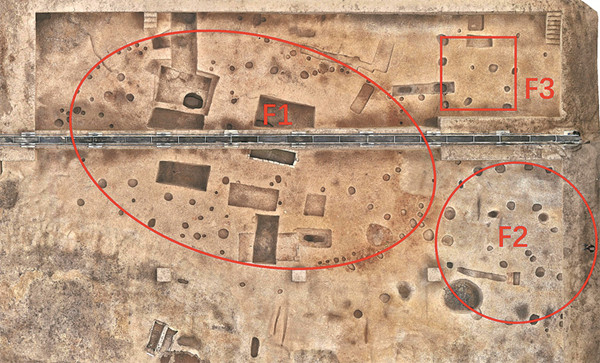
Three newly discovered buildings are seen in an aerial shot taken at the Fanshan site at the Archaeological Ruins of Liangzhu City in Hangzhou, Zhejiang province. Archaeologists hope the discoveries will help them decode early Chinese civilization. [Photo provided to China Daily]
Forty years after the milestone discovery of jade artifacts in Hangzhou, the capital of Zhejiang province, archaeologists have found new clues that are helping them decode early Chinese civilization at a pivotal site, the National Cultural Heritage Administration said at a meeting in Beijing on Wednesday.
In 1986, many exquisite jades dating back about 5,000 years were found at the No 12 tomb of the Fanshan site at the Archaeological Ruins of Liangzhu City in Hangzhou. A 6.5-kilogram ceremonial jade cong — a square tube with a circular bore — stood out as the best-known artifact and symbol of Liangzhu. It is dubbed "king of cong".
According to the latest dating results, Liangzhu culture, covering a wide area in present-day Yangtze River Delta, lasted from 5,300 to 4,500 years ago. The "king of cong" not only made archaeologists believe Fanshan was a rulers' cemetery, but also led researchers to gradually recognize the central role of Liangzhu City in the rice-cultivating and jade-worshiping regional state.
In the following decades, palaces and dams — among the world's oldest known water conservancy systems — were found in Liangzhu. The ruins were inscribed onto the UNESCO World Heritage List in 2019.
Now, a new round of excavations at the Fanshan site, which began in 2024, has inspired archaeologists to reconsider the full picture of this cemetery.
According to Wang Ningyuan, a researcher with the Zhejiang Provincial Institute of Cultural Relics and Archaeology who led the excavations, separate walled courtyards were found at the Fanshan site and in neighboring areas.
The cemetery containing the jade artifacts was located on the southwest side of a 7,000-square-meter mound, which is within a 25,000-sq-m courtyard. A group of ceremonial buildings was unearthed at the top of the mound: three architectural ruins have been found, with the largest, an oval structure, covering 316 sq m.
"This largest building was a stilt house," Wang explained. "Its structure is complicated and there's no evidence of daily life like cooking, so it was likely a high-status ceremonial building."
Remote-sensing analysis also identified roads and a pond in the courtyard.
"The basic layout of this complex remained unchanged until the end of Liangzhu culture," Wang said. "A stable burial system was formed among the aristocrats."
Viewed in a broader context, archaeologists have gained further insights. Five more similar courtyards lie on the same earthen ridge at the Fanshan site and different unearthed jade artifacts indicate that these courtyards were inhabited by people from diverse backgrounds.
"It's like people from all over the country come to live in a metropolis," Wang said. "That offers key clues to study structure and relations among different populations in Liangzhu society."
The earthen ridge holds further significance. The dams and reservoir were located to its west, while the city and 300 satellite settlements on its outskirts lay to its east.
"It showed that the whole complex, including the power center, the ceremonial structures and the water conservancy facilities, was holistically designed," Wang said. "It also demonstrated a root of the lasting wisdom of Chinese civilization: 'Controlling flood is a pillar to well govern a nation'."
"New findings in Liangzhu remind us that we cannot simply understand Fanshan as a cemetery like those in later history," Zhang Chi, an archaeology professor at Peking University, said. "It greatly expanded our horizon, but more evidence is needed to draw further conclusions."
Lei Xingshan, a veteran archaeologist and president of Beijing Union University, said that some other prehistoric sites along the Yangtze River bear features similar to Fanshan, and follow-up studies may help complete the picture of interactions among different populations along the river.
-

Why Hangzhou? Where Asia-Pacific connections create opportunities
November 18, 2026
-
The 20th Hangzhou Cultural and Creative Industry Expo
November 4, 2026
-
Hangzhou's GDP grows 5.2 percent in Q1-Q3
October 28, 2026
-
Why Hangzhou? Where Asia-Pacific connections create opportunities
November 18, 2026