

Zhejiang University scientists create self-glowing plants
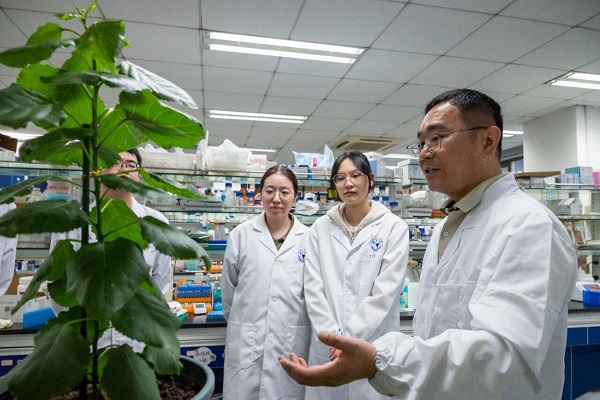
Researcher Du Hao (right) and his team members. [Photo/Zhejiang University]
Researchers at Zhejiang University have developed plants that glow visibly in the dark, turning a sci-fi vision reminiscent of Avatar's Pandora into reality.
Led by researcher Du Hao from the College of Agriculture and Biotechnology, the team engineered a sustainable bioluminescent system that allows plants to emit green light without external power or added chemicals. Unlike earlier attempts that relied on firefly genes or bacterial systems, the new method draws on a natural pathway found in glowing mushrooms.
By inserting four optimized fungal genes into plants, the researchers created a closed biochemical cycle that uses caffeic acid — a compound naturally present in most plants — as a light-emitting substrate. The process does not hinder normal growth and is clean and self-sustaining.
To boost brightness, the team combined metabolic redesign with artificial intelligence. They increased caffeic acid production from plant tyrosine while using AI-assisted gene screening to reduce competing metabolic pathways. As a result, the second-generation glowing plants are more than 20 times brighter than earlier versions, emitting light clearly visible to the naked eye for days.
The breakthrough opens the door to practical applications, from decorative landscaping and night-time gardens to low-energy lighting that consumes just a fraction of a plant's stored photosynthetic energy. Researchers also see potential in bioenergy, carbon reduction and even medical research, where plant bioluminescence could be used as a tracking tool.
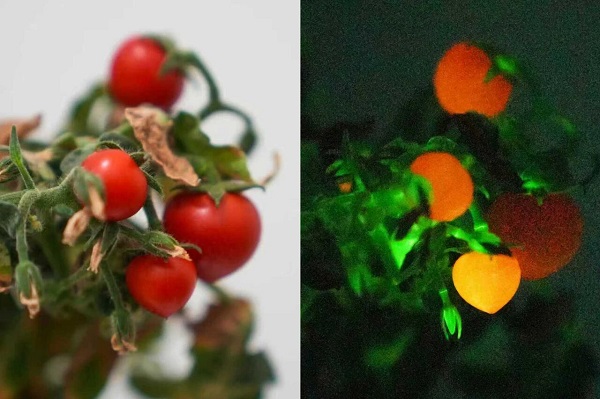
The self-glowing tomatoes. [Photo/Zhejiang University]
-

Why Hangzhou is on Nature's cover for the second time in three months
December 16, 2025
-
Hangzhou to build rocket manufacturing base
December 12, 2025
-
Hangzhou reports steady Jan-Oct economic performance
November 26, 2025
-

Global content creators discover Hangzhou's tech magic
December 2, 2025