

Zhejiang Lab, BGI launch Genos-10B to decode genome's 'dark matter'
The Genos open-source AI model is jointly developed by Zhejiang Lab and BGI Research. [Photo/Zhejiang Lab]
Zhejiang Lab and BGI Research have jointly released Genos-10B, a new foundation model for the human genome with 10 billion parameters, aiming to unlock the vast "dark matter" of non-coding DNA.
More than 98 percent of the human genome does not encode proteins and remains poorly understood. Genos marks a shift toward AI models tailored to the genome's ultra-long, high-dimensional structure. By integrating long-read data from diverse global and Chinese populations, the model captures genetic diversity at whole-genome scale while reducing population bias.
According to Zhejiang Lab, Genos moves AI from simply reading sequences toward enabling diagnosis and clinical decision-making. In benchmark tasks, including rare disease diagnosis, the model has shown a near expert level of accuracy by jointly reasoning over genetic sequences and clinical phenotypes.
The team released both 1.2B and 10B versions to support use from personal computers to large computing clusters, alongside an open-source roadmap. China's open-source AI community ModelScope, based in Hangzhou, described Genos as a paradigm shift — from modeling local sequences to interpreting entire genomes — positioning the project at the forefront of bio-AI research.
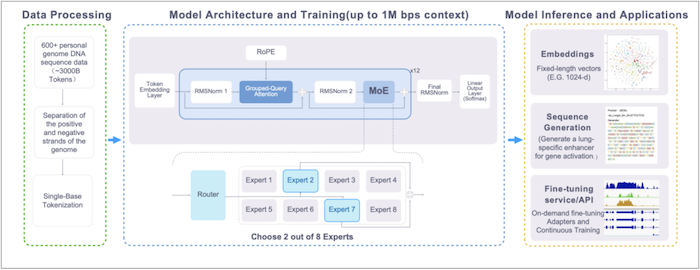
The user interface of Genos. [Photo/Zhejiang Lab]
-

Hangzhou prepares for 147 million cross-regional trips during Spring Festival travel rush
February 3, 2026
-
Chinese cities turn waste into resources for greener future
February 2, 2026
-
From labs to everyday life: Hangzhou's AI moment
January 29, 2026
-

Global content creators discover Hangzhou's tech magic
December 2, 2025