
Innovative research universities gaining ground
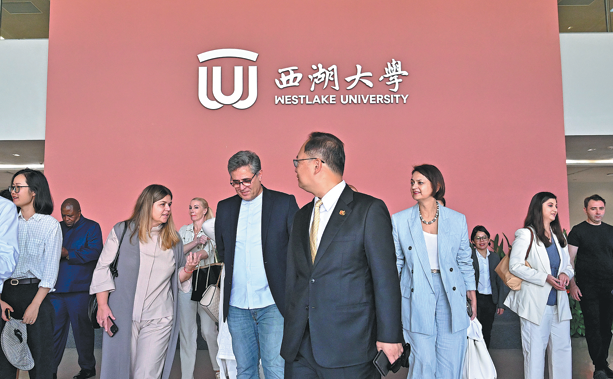
Diplomats visit Westlake University in Hangzhou, Zhejiang province, in October. China's Ministry of Foreign Affairs organized the event and invited representatives from 19 countries and international organizations to visit the new research-oriented university. ZHAO WENYU/CHINA NEWS SERVICE
New establishments push educational reform and technological advancement
The concept of the new type of research university has, in recent years, become a buzzword across China's higher education and academic communities.
On Dec 6, Great Bay University held its inauguration ceremony in Dongguan, Guangdong province — a major advanced manufacturing hub in the Guangdong-Hong Kong-Macao Greater Bay Area — marking the official launch of a new type of research university with a strong focus on science and engineering.
A similar milestone was reached on Nov 28, when the Eastern Institute of Technology, Ningbo (EIT), a new type of research university, was officially unveiled in Ningbo, Zhejiang province.
In addition to Great Bay University and EIT, institutions frequently cited as representatives of the new type of research university include Southern University of Science and Technology, ShanghaiTech University, Westlake University, Fuyao University of Science and Technology, Shenzhen University of Advanced Technology, and University of Health and Rehabilitation Sciences. Meanwhile, Qiantang University, funded by Zhong Shanshan, founder of bottled water company Nongfu Spring, is currently under preparation in Hangzhou, Zhejiang.
China's higher education sector has expanded rapidly in recent years. According to a statistical bulletin on national education development for 2024 released by the Ministry of Education in 2025, the number of postgraduate students nationwide reached 676,300 doctoral students and 3.42 million master's students, while regular undergraduate students reached 20.86 million.
Against this backdrop, a key question arises: Why does China need to build the new type of research university?
The question was extensively discussed at the inaugural Higher Education Forum hosted by EIT on Nov 29, where leading scholars and experts in China's higher education sector — including heads of eight such research universities — gathered for an in-depth exchange.
Lin Jianhua, a former president of Peking University with a traditional university background, shared his distinctive views on the emergence of new institutional types.
"In recent years, many new universities have been established globally, most of which follow traditional models, as drawing on existing systems and proven experience is often the easiest path," Lin said. However, he noted that two categories of institutions merit particular attention: emerging universities and the new type of universities.
According to Lin, emerging universities aim for excellence across the board, striving to outperform in multiple dimensions and often possessing distinctive features. "They need clear philosophies, well-defined positioning and strong institutional identities, and must seize every opportunity to pursue excellence and continuous innovation. A representative example is the Hong Kong University of Science and Technology," he said.
The new type of universities, by contrast, are designed to respond to contemporary challenges. They seek to break away from conventional educational philosophies and established practices, explore new paths in academic development, educational models and university design, and serve as benchmarks and references for broader reform in higher education.
"Emerging universities focus more on their own growth and pursuit of excellence, while the new type of universities emphasize model innovation and institutional reform," Lin said.
For many experts, the greatest value of the new type of research university lies precisely in its transformative contribution to reforming traditional higher education models.
Shi Yigong, president of Westlake University, said that the new type of research university represents both the self-evolution of university organizational forms and knowledge production models, and a response to social development and national strategic needs.
China has made a top-level strategic design, emphasizing the integrated development of education, science and talent. It is a remarkable shift, Shi said, citing a report from a Communist Party of China Central Committee plenary session in 2024. "A decade ago, education in government work reports was mainly framed as a livelihood issue, disconnected from science and talent. This is the first time the three have been placed together as a strategic priority."
In China's context, Shi added, the new type of research university should act as a catalyst. "It should not simply be a 'catfish' that stirs the water, but also a catalyst and a spark," he said. "It may not compete on scale, but through reform it should challenge traditional universities and stimulate change across the system."
Wang Shuguo, president of Fuyao University of Science and Technology, noted that the rise of the new type of research university is closely linked to breakthroughs in the ongoing technological revolution, which are reshaping human cognitive boundaries and altering knowledge frameworks established during previous industrial revolutions.
"As existing cognitive boundaries are broken, new knowledge is continuously generated at the intersections of disciplines, and traditional disciplinary divisions can no longer keep pace with technological development," Wang said. This, he added, marks a shift in knowledge production from quantitative accumulation to qualitative transformation, requiring universities to assume responsibility for restructuring humanity's knowledge systems.
"This is a shared responsibility of all universities, but the new type of research universities should take the lead," Wang said, noting that their greater institutional flexibility and lighter historical burdens enable them to act as a "light cavalry".
"The new type of research universities are meant to do what traditional large-scale universities have not done, do not want to do, are unwilling to do, or are unable to do," he said.
From their inception, the new type of research universities in China have been entrusted with such a mission.
Jiang Hong, Party secretary of Southern University of Science and Technology, recalled that when the university — among China's first batch of the new type of research universities — was approved in 2012, its founding mandate already included the exploration of a modern university system.
Thirteen years later, Chen Shiyi, president of EIT, echoed this vision at the university's founding ceremony."We have explored new forms of education, new disciplinary layouts, new training models, new governance structures and new management systems," he said. "These efforts ensure the correct direction of the university, maintain institutional vitality, and provide solid safeguards for its long-term development."
Reform, however, is never easy — particularly for universities. What, then, are the defining features of the exploration undertaken by the new type of research universities?
EIT summarizes its positioning with four principles: high-caliber foundation, compact yet distinguished, research-oriented, and globally engaged. In the view of Fan Jianping, president of Shenzhen University of Advanced Technology, these four traits are widely shared among the new type of research universities.
"While each new type of research university has its own characteristics, they follow a highly consistent development logic," Fan said. He observed that many such institutions are located in coastal regions, mainly due to three factors: growing demand for high-quality higher education amid rapid development and economic transformation; urgent needs for talent and technological support during urban upgrading; and expectations from local governments for higher efficiency and returns on educational investment.
Shi Yigong agreed that China's new type of research universities share certain commonalities, such as a strong commitment to reform and innovation, the pursuit of excellence in specific fields or disciplines, and openness and collaboration with governments and society.
At the same time, he emphasized that each institution's reform path reflects a different interpretation of what "new" means.
Taking Westlake University as an example, Shi noted that quantitative metrics — such as publication counts, impact factors, citation rates, academic titles or awards — often constrain universities' potential. At Westlake, however, such indicators are not the primary criteria for academic evaluation.
"Someone may stay with just one paper, because it represents an indispensable breakthrough in the field," he said. "Another may publish 20 papers, but if they are all follow-up studies, they may not fit Westlake's evaluation system. Having no quantitative metrics does not mean having no standards."
Located in Hangzhou, Zhejiang, Westlake University is China's first new type of research university supported by both public and private funding. With its predecessor, the Westlake Institute for Advanced Study, established in 2016, the university aims to cultivate top talent, achieve breakthroughs in basic research and frontier technologies, and advance human development through science and innovation.
Several universities were established around the same time as Westlake, and many of their presidents are here today, Shi said. "But the meaning of 'new' differs significantly among these institutions. Each has its own characteristics, and I believe this diversity is a very good thing. Reform requires different paths and experiments — only then can we see which approaches truly work and contribute distinctive solutions to China's higher education system."
chenye@chinadaily.com.cn
-
CICAF 2026 opens as Hangzhou advances vision of animation hub
June 17, 2026
-
China Intl Cartoon & Animation Festival opens in Hangzhou
June 15, 2026
-
Hangzhou emerges as a global innovation, diplomacy hub
June 10, 2026