
Nation's standards grow in influence

SHI YU/CHINA DAILY
Hangzhou ISO meeting addresses need to make scenic spots, hospitality more accessible
China hosted its first-ever ISO tourism technical committee meeting recently, on the back of four updated national standards for the tourism sector, highlighting the nation's push to play a bigger role in the rollout of international standards.
In mid-May, the International Organization for Standardization's Technical Committee on Tourism and Related Services (ISO/TC 228) held its plenary meeting in Hangzhou in East China's Zhejiang province. It was the first time in the committee's 21-year history that the gathering had taken place in China.
The timing was no coincidence as just weeks earlier, China's State Administration for Market Regulation released four new recommended national standards covering tourist shopping venues, smart scenic area operations, senior travel services and accessible hotel services. Three of them take effect on Aug 1, while the smart tourism standard follows on Nov 1.
Together, the new standards and the Hangzhou meeting point to China playing a growing role in shaping tourism standards internationally, officials and industry experts said.
They described the four updated national standards, all recently issued under the national tourism standardization technical committee (TC210), as a major step forward.
The most notable is the accessible tourism service standard for hotels, which marks China's first national standard in this category. It aligns with the ISO international standard Accessible tourism for all — Requirements and recommendations (ISO 21902), which served as the basis for a new Chinese national standard issued just last month — modified to fit local conditions and regulatory frameworks, according to authorities.
The standard moves beyond the traditional focus on wheelchair users to cover all types of travelers with accessibility needs, including seniors, families with young children and people with temporary injuries. It sets quantitative requirements for 18 categories of facilities and outlines service protocols for six core scenarios.
In the area of tourist accommodation, the standard specifies accessible guest room configurations, including door widths and grab bar installations at precise heights. The information and communication protocols demand that all digital systems — including websites, mobile apps and self-service kiosks — comply with international accessibility standards. The training section requires ongoing staff training and the employment of personnel with specialized knowledge in areas such as sign language and Braille.
"This is a shift from 'one-time hardware installation' to 'long-term service operations'," said Liu Jianming, a senior official from the ministry's Tourism Quality Supervision and Management Office.
The smart scenic area operations standard (GB/T 30225-2026) is the first revision since its original release in 2013. It adds a new chapter on data management and breaks down the old "application service platform" into four distinct sections, consisting of smart management, smart service, smart marketing and smart experiences. The goal, according to the standard, is to make tourism operations "digital, connected and intelligent" from end to end.
Two other released standards target specific pain points. The tourist shopping venue standard requires at least 12 themed activities per year, with cultural experiences making up no less than half, and mandates 48-hour returns and a minimum 95 percent visitor satisfaction rate. The senior travel service standard, a completely new issuance, addresses China's rapidly aging population by setting rules on itinerary pacing, staff training and emergency protocols.
Vote of confidence
The domestic push reflects China's deepening commitment to tourism standardization, which has not gone unnoticed abroad.
The decision to bring the ISO/TC 228 plenary meeting to Hangzhou was made by a vote of all member states.
"We applied two years ago and won," Liu said, adding that Hangzhou's accelerated development over the past few years represents the general tourism development in China.
During the ISO/TC 228 plenary meeting, more than 60 international delegates from 33 countries and four international organizations spoke positively of tourism operations in the city.
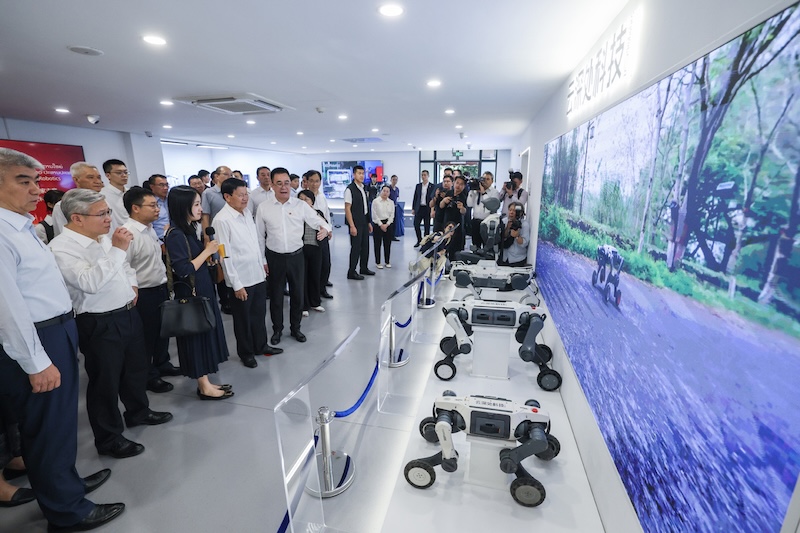
During the weeklong meeting, they visited rural villages, a vocational college, tech companies including Ant Group, and cultural heritage sites.
Manuel Otero, the Spanish chairman of ISO/TC 228, said Hangzhou exceeded his expectations.
"I see a very modern city — something I did not expect. Everything is really, very, very well done," he said.
What impressed him greatly was a visit to the Tourism College of Zhejiang, where students in the tea culture program must earn three advanced professional certifications before graduation. During the visit, they presented a standard Song Dynasty (960-1279) tea ceremony that blended centuries-old traditions with contemporary design.
"What I saw yesterday is absolutely with the highest standards," Otero said. "The students smile. They have a good attitude. They have a good mood. We feel that they want to do it — and that is very important for professionals."
Maria Velasco Gonzalez from Spain serves on the ISO/TC 228 working group developing an international standard for smart tourist destinations.
During her visit to Hangzhou, she bought souvenirs and tried her hand at the Song Dynasty tea-whisking ceremony. She was impressed by the meticulous explanation from the instructor that helped her better understand not just the operation but the culture and history behind it.
"If I should rate from 1 to 10, you can have a 10," she said about the experience.
Growing role
China became a participating member of ISO/TC 228 in 2020. In just six years, it has taken on an increasingly prominent role by co-leading 12 international standard projects and pre-work items under discussion, four of which have already been published, according to a senior official with the department of science, technology and education at the Ministry of Culture and Tourism.
During the Hangzhou meeting, Chinese delegates made progress in six international standard projects led by China, including sustainable tourism, camping tourism and smart tourism. They also made three new proposals, covering rural tourism and tourism marketing. All were preliminarily approved and will move into the next process.
"We are putting forward our successful practices through the ISO process," tourism official Liu said. "At the same time, we are also learning from other countries."
A senior official with the Standardization Administration of China noted that TC 228 has so far published 60 international standards, with 19 more in development. She cited the United Nations' tourism data showing that global international tourist arrivals reached 1.52 billion in 2025, contributing 9.8 percent to global tourism GDP.
"The vitality of standards lies in their implementation," the official said.
Liu said that the country is considering a standard for pet-friendly tourism — hotels and attractions that welcome travelers with pets.
"Many people have pets at home. Without suitable places to go, the pet owners themselves are less likely to travel. A standard would boost development of new business formats and help offer high-quality products and services," he said.
That might seem a long way from accessible ramps and smart data platforms, but it reflects the same logic that standards are tools to solve real problems, participants at the Hangzhou meeting said. As the Hangzhou meeting showed, the solutions China is developing are increasingly attracting global attention.
"They are not just visiting," Liu said of the international delegates. "They are also seriously learning from China's experience."
As tourism becomes more digital, inclusive and experience-driven, officials and experts at the Hangzhou meeting agreed that standards are increasingly shaping not only how people travel, but how destinations compete globally.
yangfeiyue@chinadaily.com.cn