

Ancient silk finds new life in China's youth-driven fashion revival
China's ancient silk traditions are finding a younger audience as heritage fabrics are reimagined for everyday wear and popular culture.
Popular Labubu dolls dressed in miniature outfits crafted from centuries-old silk fabrics such as Song brocade, gambiered Guangdong gauze and luo are on display at the showroom of a silk manufacturer in Haining city, east China's Zhejiang Province.
Hu Mingyi, general manager of Qianshu Textile Technology Co., Ltd., posted a few handmade outfits for dolls on social media and received an unexpectedly warm response.
Last October, he was commissioned to design and produce a custom set of Spring Festival-themed doll outfits, delivering the finished pieces within 10 days. The viral success of the silk doll clothes drove the company's monthly sales of silk fabrics past 30,000 meters.
Scaling up production of heritage fabrics is no small feat. Luo fabric, prized in ancient China, requires an exceptionally intricate weaving process. Starting in 2017, the company partnered with several universities to develop a modern luo-weaving technique.
A new loom developed by the company can produce 70 meters of fabric per day, compared with just 6 or 7 meters on a traditional loom. The company's latest luo fabric is so lightweight that a women's top weighs under 50 grams and can be folded to fit inside a matchbox.
Wensli Group, a well-known Chinese silk producer in Hangzhou, Zhejiang Province, is taking a different approach by combining traditional craftsmanship with artificial intelligence. The company used AI-generated content technology to train a scarf design model on the works of more than 600 artists, allowing it to produce customized patterns at scale.
In Lunjiao subdistrict, Shunde district, Foshan city, south China's Guangdong Province, a different silk revival is taking shape around gambiered Guangdong gauze, or Xiangyunsha in Chinese, a prized traditional silk fabric.
Dubbed "soft gold," the fabric undergoes a complex production process that includes repetitive dyeing with natural plant extracts, sun-drying and coating with river mud. In 2008, the dyeing and printing techniques for making Xiangyunsha were listed as a national intangible cultural heritage (ICH).
Huang Xiaotong, a woman born in the 1990s, opened a small Xiangyunsha store in a century-old residence to make the fabric more accessible to younger consumers.
Instead of relying on advertising, she built her business through word of mouth, encouraging hesitant visitors to try on garments. Her shop offers streamlined, contemporary cuts — straight-leg trousers, skirts, shirts and dresses — that she says pair easily with T-shirts and jeans for a relaxed, everyday look.
Zhou Xiaogang, head of the Lunjiao Xiangyunsha Association, is a municipal-level inheritor of the Xiangyunsha dyeing and printing techniques with nearly 30 years of experience in the industry. He endorsed the approach but stressed that innovation must not come at the cost of craftsmanship. The association is working to establish grading standards to help consumers make informed purchases.
In northwest China's Xinjiang Uygur Autonomous Region, the region's signature Atlas silk, whose weaving and dyeing techniques were listed as a national ICH in 2008, is undergoing a similar transformation. Once associated mainly with loose dresses worn by older women, the fabric struggled with issues such as colors that faded easily and high handcraft costs that kept younger buyers at a distance.
In recent years, designers born in the 1990s and 2000s, armed with a sharp eye for fashion trends and grounded in solid market research, have been blending Atlas silk with fabrics such as cotton, linen and denim, while using jacquard weaving, embroidery and printing to highlight its intricate patterns.
Repositioned around new Chinese-style fashion, Atlas silk has been reinvented across a full range of contemporary silhouettes, from office-ready suits and belted trench coats to qipao, evening gowns and wedding dresses.
"In recent years, a wave of Atlas silk-inspired merchandise has flooded the market, with many brands incorporating its traditional elements into their visual identity," said Cheng Yingfen, executive deputy director of the Xinjiang Atlas Silk Research and Promotion Center. "Atlas silk is gradually becoming a cultural IP in its own right."
-
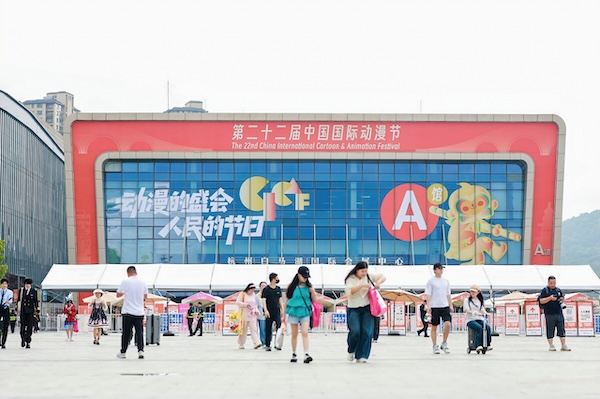
CICAF 2026 opens as Hangzhou advances vision of animation hub
June 17, 2026
-
China Intl Cartoon & Animation Festival opens in Hangzhou
June 15, 2026
-
Hangzhou emerges as a global innovation, diplomacy hub
June 10, 2026