

Hangzhou community delivers hot meals after resident's message sparks action
At 11 a.m., the aroma of lunch begins to drift through Chunjiang community in Shangcheng district, Hangzhou, east China's Zhejiang Province. Elderly residents gather at the community's meal service site, chatting as they wait for the meal service to begin.
Just a year and a half ago, many of these seniors had to walk nearly a kilometer to reach the nearest restaurant for a meal. Today, they can enjoy hot lunches right at their doorstep. It all began with a simple message.
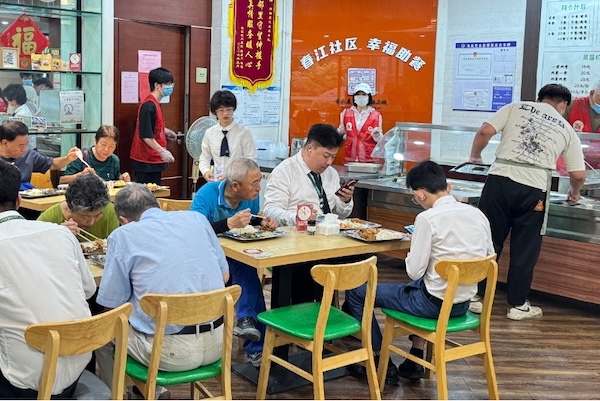
Residents eat lunch at a community meal site in Chunjiang community, Shangcheng district of Hangzhou, east China's Zhejiang Province, June 12, 2026. (People's Daily Online/Wu Chaolan)
Zhu Shujian, a retired resident of Chunjiang community, had long noticed the problem during his daily walks and chats with neighbors. The community is home to more than 900 residents aged 60 and above, and mealtime was a frequent concern.
"Many seniors here live alone. Cooking for one is troublesome, and eating out is not always convenient," Zhu said.
After hearing the same worries again and again, Zhu decided to speak up. He left a message on the Leaders' Message Board, a section on the People's Daily Online website, suggesting that the community set up a meal service site for elderly residents.
Turning a message into warm meals
With that message, a small wish from the neighborhood began to turn into action. The next morning, He Mu, Party secretary of Chunjiang community, received Zhu's message.
"Even before we received the message, we had been thinking about how to address the dining needs of elderly residents," He recalled. "But when we saw the message, we felt it had become urgent. We had to turn the idea into reality."
Soon, He and his colleagues began knocking on doors across the community. They sat down with seniors, asked how they managed daily meals, and noted down their concerns one by one. Before the project was launched, the visits had covered more than 80 percent of the community's elderly residents.
But turning this shared wish into a real service was not easy.
From finding a suitable space to meeting catering regulations, He spent a great deal of time coordinating with different parties and discussing possible solutions. Space was limited in the old residential community, so a traditional canteen with an on-site kitchen was not practical. After repeated talks with the property management company, the homeowners' committee and catering providers, the community decided to set up a meal service site instead.
Meals would be prepared in a nearby centralized kitchen, delivered to the community, and kept warm on site, a practical solution that allowed seniors to buy hot meals close to home.
"As grassroots workers, we cannot just collect problems and leave them there," He said. "We have to coordinate resources and come up with a concrete, workable plan."
After the meal service site plan was settled, the community began looking for a catering partner. That was when they reached out to Zhao Man, who had experience running neighborhood canteens.
At first, Zhao hesitated. Community meal services required fresh food, affordable prices and dishes suited to elderly residents' tastes, but left little room for profit. What changed her mind was the persistence of He and Zhu, as well as the government's continued efforts to make the project happen.
Zhao also thought of the elderly members in her own family. "Everyone has seniors at home," she said. "At first, I was not sure whether we could make it work. But doing something is always better than doing nothing. If we do a little every day, it will add up."
For Zhao, serving nearly 100 elderly residents each day made the effort worthwhile. "When so many seniors can have a proper meal here, I feel this is something meaningful," she said.
With efforts from all sides, the meal service site opened within two months after Zhu sent his message.
On the first day, more than 200 elderly residents came. For Zhu, seeing his suggestion turn into a real place filled with people, food and laughter was deeply moving.
"After I left the message, they really moved at full speed," Zhu said. "You could feel that they had taken people's needs to heart. The government workers did something that truly touched us."
The site soon became more than a place to buy lunch. After meals, seniors stayed to chat and share stories, bringing warmth to days that used to feel lonely. "Everyone gave them a thumbs-up," Zhu said.
Keeping the care going together
Opening the meal service site was only the first step. The bigger question was how to make it serve seniors better — and how to keep it running in the long term.
During the trial run, the catering company had to assign several workers to the site for cashier duty, cleaning, clearing trays and serving food. As the service continued, labor costs became a real pressure. The community then began looking for ways to help.
Zhu was among the first to step forward, helping form a volunteer team in the community whose members take turns assisting with meal distribution and keeping things running smoothly. For Zhu, volunteering was also a way to protect the service he had helped bring to life.
"If we want this place to keep running, we have to help reduce the company's costs," Zhu said. "Only when the company continues operating can seniors here continue to benefit."
The shared commitment deeply moved Zhao Man. "Zhu comes to help almost every day, and so do other volunteers and community workers," Zhao said. "Seeing them give so much without asking for anything in return really touched me. At first, I felt it was very difficult to keep the service going. But with so many people doing their part, I felt that no matter how hard it was, we should carry on."
Today, the meal service site is running smoothly, but the community's work continues.
Menus are shared in a group chat for elderly residents, where seniors can give feedback on dishes and make suggestions. He Mu still stops by the site regularly, talking with seniors, checking food portions, hygiene and service details, and learning what else can be improved. Every Saturday, volunteers also deliver meals to residents aged 90 and above who have difficulty coming in person.
For He, serving the people is part of his duty as a grassroots worker. But seeing residents, volunteers and the catering company all working together has given him even greater motivation to keep improving the service.
"When our work makes residents' lives a little better and brings us closer to them, we feel truly rewarded," He said. "Their praise means a lot, but their trust means even more."
For Chunjiang community, the meal service site is not a finished project, but an ongoing promise to keep listening, adjusting and bringing care closer to home. From Zhu's message to He's coordination, from Zhao's commitment to the volunteers' daily support, the story shows how the spirit of serving the people is passed on through ordinary hands and carried forward in everyday acts of care.
-

In pics: AI exhibition by West Lake in Hangzhou
June 25, 2026
-
CICAF 2026 opens as Hangzhou advances vision of animation hub
June 17, 2026
-
China Intl Cartoon & Animation Festival opens in Hangzhou
June 15, 2026