
West Lake's hidden axis: Historian uncovers Hangzhou's ancient urban design
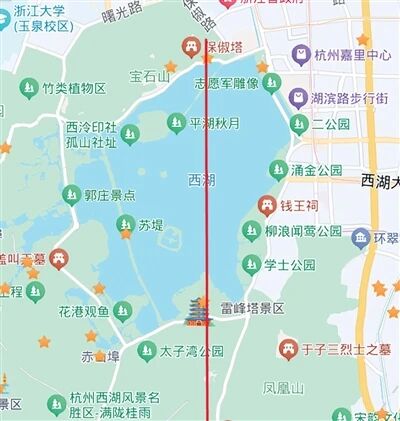
The red line indicates the West Lake axis linking Baochu Pagoda and Leifeng Pagoda. [Photo/Hangzhou Daily]
A packed public lecture in Hangzhou on July 18 explored the city's little-known "West Lake axis", offering fresh insights into the legacy of the ancient Wuyue Kingdom.
Zhejiang University historian Chen Zhijian introduced what he believes are Hangzhou's two historic axes: the city's north-south urban axis, located along Southern Song Imperial Street, and a deliberately planned West Lake axis linking Baochu Pagoda and Leifeng Pagoda.
According to Chen, the two pagodas, built during the Wuyue Kingdom (907–978), stand on nearly the same meridian, suggesting they were intentionally positioned to create a symbolic axis across West Lake. He said the alignment, along with nearby royal tombs and historical sites, may reflect sophisticated urban planning by the Wuyue rulers, though further research is ongoing.
Chen also traced the evolution of Baochu Pagoda's name, arguing that its modern Chinese name likely originated from a centuries-old misunderstanding rather than historical records, calling it "an innocent misunderstanding" that has endured through time.
The lecture is part of a new cultural series launched by Hangzhou's cultural authorities to present the history of the Wuyue Kingdom through accessible stories, reflecting growing public interest in the city's millennium-old heritage.
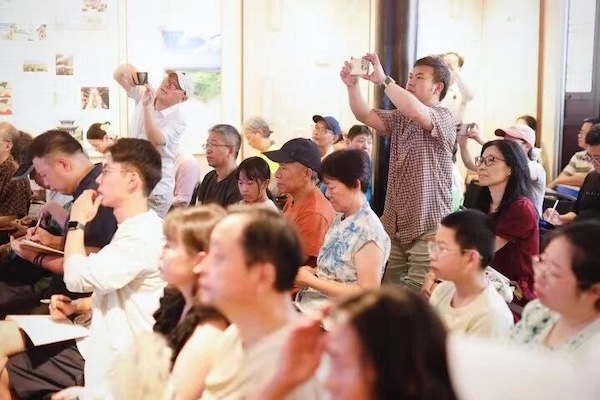
The lecture attracts many attendees. [Photo/Hangzhou Daily]
-

Global open-source AI Challenge launches in Hangzhou
July 22, 2026
-
Zhejiang's cultural legacy helps bring 'world's largest encyclopedia' home
July 9, 2026
-
Embrace the future
July 6, 2026