
Space-AI computing solutions paving way for faster smart tech development
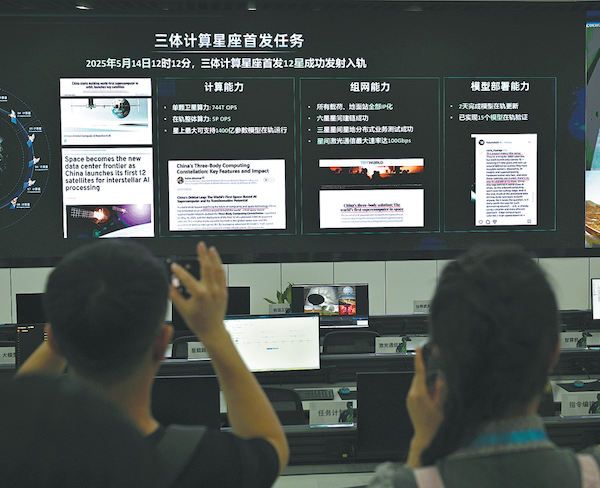
Visitors learn about the Three-Body computing constellation, a space-AI orbital computing system, at Zhejiang Lab in Hangzhou, Zhejiang province, on Monday. MAN HUIQIAO/CHINA NEWS SERVICE
Space computing is opening a new front in global artificial intelligence innovation, as a flood of satellite data strains ground-based processing and China's Three-Body computing constellation takes computing power and AI models into orbit to turn raw observations into usable intelligence at the source.
"One remote-sensing satellite can generate about 0.1 petabyte of data per day. By a conservative estimate, more than 3,000 remote-sensing satellites will be in orbit by 2032, together producing about 300 PB of data every day," said Li Chao, chief engineer of the space computing system research task at Zhejiang Lab. "Processing that volume would require roughly 100,000 servers on Earth, which shows the scale of the computing-power shortage in space."
That looming shortage is the problem the Three-Body computing constellation was designed to address. Initiated by Zhejiang Lab and built with global partners, the project is organized around three tasks: putting substantial computing power into orbit, interconnecting satellites and sending AI models into space.
The first allows on-orbit data processing. The second uses laser and microwave communications to let interconnected satellites exchange data and work together, while the third puts remotely updatable AI models on orbit so tasks such as coordinated astronomical observation and short-term weather forecasting can be handled largely in space, Li said.
The project's first 12 computing satellites, launched in May 2025, have reached a combined computing capacity of 5 quadrillion floating-point operations per second, making it the world's largest space-computing constellation by current on-orbit capacity.
The value of that capacity becomes clearer when set against the conventional satellite workflow. Most satellites must send raw observations to Earth for analysis, but limited ground-station bandwidth and transmission delays mean that less than 10 percent of their data can be effectively used and processing can also take hours or even days, Li said.
In this regard, space also needs intelligence to allow such vast amounts of data to be better utilized through on-orbit services, he added.
"That's why AI should be brought into space," Li said.
The constellation has to date deployed 20 AI models, including an 8-billion-parameter space-based remote-sensing model, the largest-parameter model of its kind currently operating on orbit.
The constellation has also been exploring real-life applications such as autonomous fire detection and real-time alerts, crop-yield monitoring and on-orbit tracking of atmospheric pollution, which are expected to largely shorten the time between observation and action in disaster response and environmental management, Li said.
This focus on extracting more actual value from each satellite also shapes China's technical route.
"The central challenge is how to leverage AI models to fully unlock the value of enormous data generated in space," Li said, adding that satellite numbers would produce diminishing returns after a network reached sufficient coverage.
The project plans to build a constellation of about 100 satellites by 2027 and expand it to a network on the order of 1,000 satellites by 2032. Li estimates that a network of that scale could revisit any point on Earth roughly every three minutes.
"The longer-term goal is for a space-based AI model to manage the network as a whole and turn its observations into services that can be used on Earth," he said.
-
Global open-source AI Challenge launches in Hangzhou
July 22, 2026
-
Zhejiang's cultural legacy helps bring 'world's largest encyclopedia' home
July 9, 2026
-
Embrace the future
July 6, 2026