

Hangzhou's 'Six Little Dragons' and 'New Eight Steeds' to debut together at digital trade expo
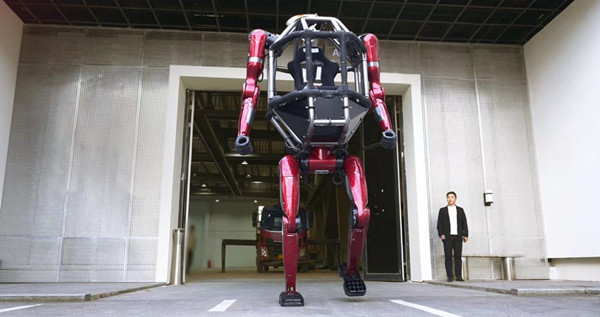
The GD01 passenger-carrying transforming mecha developed by Unitree Robotics. [Photo provided by Hangzhou International Convention and Exhibition Group to Tide News]
The fifth Global Digital Trade Expo (GDTE) will be held from Sept 23 to 27 at the Hangzhou Grand Convention and Exhibition Center in Zhejiang province, bringing together cutting-edge technologies from Hangzhou's emerging digital industries and showcasing the "Six Little Dragons" and "New Eight Steeds" together for the first time.
The "Six Little Dragons" refers to six fast-growing Hangzhou technology startups that have gained national attention for their rapid development, while the "New Eight Steeds" refers to eight established local technology companies recognized for their strong innovation capabilities and growth potential.
Themed "Meet the AI Future at GDTE," the event will cover an exhibition area of 170,000 square meters and attract participants from 121 countries and regions, with international exhibitors accounting for more than 20 percent.
A themed pavilion will showcase products ranging from passenger-carrying transforming mecha and humanoid robots to quantum computers, brain-computer interfaces, and space-based AI.
The expo's technology showcase highlights three trends: increasingly specialized technologies, denser computing infrastructure, and stronger links between innovation and real-world applications.
Unitree Robotics will display its mass-produced GD01 passenger-carrying transforming mecha, alongside humanoid and quadruped robots; Rokid will unveil its second-generation smart glasses; and MatriQ will showcase an integrated large-scale neutral-atom quantum computer.
The pavilion will feature space AI technologies, including AI computing satellites and concepts for lunar robots and data centers, as well as brain-computer interface applications developed by Zhejiang University. Visitors can also experience VR-based brain visualization and control a robotic arm using brain signals.
-
Hangzhou showcases deeper global ties 10 years after G20 Summit
September 6, 2026
-
Hangzhou to host two major AI events in September
September 4, 2026
-
Przewalski's horses set to return to Xinjiang wild
September 1, 2026
-
Improved business environment boosts global trade
September 8, 2026