

Zhejiang steps up to cultivate more 'new technology dragons'
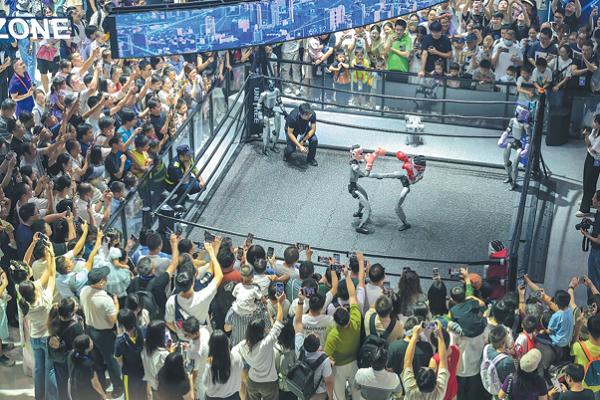
A boxing match between two robots from Unitree Robotics attracts a large crowd during the Fourth Global Digital Trade Expo in Hangzhou, Zhejiang province, on Sept 25, 2025. [Photo by Dong Xuming/For China Daily]
When German Chancellor Friedrich Merz visited the tech hub of Hangzhou, Zhejiang province, in February, he was invited to try on a pair of AI glasses made by local startup Rokid. Several German executives in his delegation were so impressed that they placed orders on the spot.
Speaking at an open meeting of the Zhejiang delegation during the ongoing two sessions late last week, Liu Jie, governor of Zhejiang province, cited the episode as evidence of growing international interest in the province's technology prowess.
Zhejiang, long known for its private sector dynamism and digital economy, is now betting heavily on artificial intelligence to sustain growth and strengthen its innovation ecosystem.
Together with a cluster of fast-growing tech firms, dubbed Hangzhou's six little dragons — DeepSeek, Unitree Robotics, Game Science, DEEP Robotics, BrainCo and Manycore Tech — the city has become one of China's most closely watched innovation hubs.
"Among these six companies, four are preparing for stock market listings, and most recorded triple-digit revenue or output growth last year," said Yao Gaoyuan, mayor of Hangzhou and a deputy to the 14th National People's Congress.
Now, the city seeks to replicate those successes by cultivating a broader pipeline of emerging startups. "We want Hangzhou to become an incubator for more 'tech dragons'," Yao said.
To that end, the city launched a policy package known as Runmiao, or nurturing seedlings, program. It is designed to identify promising early-stage technology companies through an innovation points evaluation system.
Selected startups can receive a variety of government support — including equity investment, loans, subsidies, guarantees and insurance — under what officials describe as a coordinated fiscal and financial toolkit.
Hangzhou also established a Runmiao fund with an investment horizon of up to 20 years, aimed at providing long-term capital for technology startups during their early growth stages, Yao added.
The approach reflects a broader strategy across Zhejiang, where policymakers see innovation-driven growth as central to the province's development and to China's national technology goals.
AI features prominently in the local government work report in 2026, which calls for building a "high ground" for AI innovation and accelerating the expansion of the sector. The province aims to increase revenue from its core AI industries by more than 20 percent this year.
As companies race to deploy large language models, robotics and intelligent hardware across industries in recent years, the province's AI sector already generated more than 710 billion yuan ($102.65 billion) in revenue last year.
To identify the next generation of tech leaders, officials also screened nearly 400 candidate companies across the province and selected 96 startups as "new technology dragons", with AI firms accounting for 57 percent of the list.
Wang Xingxing, founder of Unitree Robotics, said in an earlier interview that thanks to Zhejiang's fertile ground for policy and innovation, an increasing number of private tech enterprises are achieving breakthroughs.
"Unitree will continue to focus deeply on robotic AI large models, remaining committed to creating high-performance, low-cost products for China and the world," he said.
-
Zhejiang steps up to cultivate more 'new technology dragons'
March 10, 2026
-
China's main development targets for 2026
March 5, 2026
-
Hangzhou builds 'global home port' for robotics industry
March 3, 2026
-

Global content creators discover Hangzhou's tech magic
December 2, 2025