

Eastern philosophy flows through China pavilion at Malta Biennale
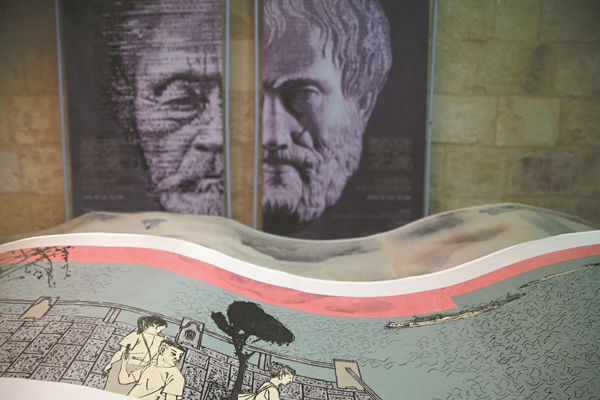
Mutual Learning among Civilizations: The Mohists and Peripatetic School, a woodblock print of Ying Jinfei, on show. [Photo provided to China Daily]
Chen Qi, a veteran print artist based in Beijing, is among the pioneers reviving this centuries-old art form through a semiabstract and expressive approach that honors its timeless beauty. His work on display, Spring River No 2, resembles a bird's-eye view of expansive emerald waters. Historically, woodblock printing was widely used to print texts or produce figurative images for decoration and festive celebrations.
Chen's minimalist explorations push the possibilities of this folk tradition in contemporary expression.
Minimalism is also the hallmark of paintings by Liang Quan, who is based in Shenzhen, Guangdong province.
It not only refers to the grids that he revisits and the muted palette he uses; it also conveys a meditative Zen state — the unity of the opposites of shi (the fullness) and xu (the emptiness) that he has explored for years.
In his two Chinese shuimo (ink and water) paintings on show, Tea and A Hint of Coffee — No 1 and No 2,Liang used leftover tea and coffee as pigments to open up a dialogue on the lifestyles of the East and the West.
Through imagery and the exploration of techniques, Ying says that the Chinese pavilion aims to create a poetic atmosphere that will usher visitors "into a state of 'clarity', allowing them to feel their minds purified, and have a longing for a harmonious world".
In June, the pavilion will head to Pulchri Studio, an artists' association and gallery founded in 1847, in The Hague, the Netherlands, marking the 10th anniversary of the China Cultural Center in the country.
-
China's import push offers opportunities
March 16, 2026
-
Global goods expo to boost imports and consumption in Hangzhou
March 13, 2026
-
Hangzhou charts new path for global cultural exports
March 11, 2026
-

Global content creators discover Hangzhou's tech magic
December 2, 2025